
"His Last Groomer Never Needed a Muzzle": How to Set a Muzzle Policy
Every groomer hears it, usually at pickup, usually from the owner of a dog that just went for your hands. Here is how to word a muzzle policy, how to flag the dog so it carries to every future booking, and the scripts for the conversation at the desk.

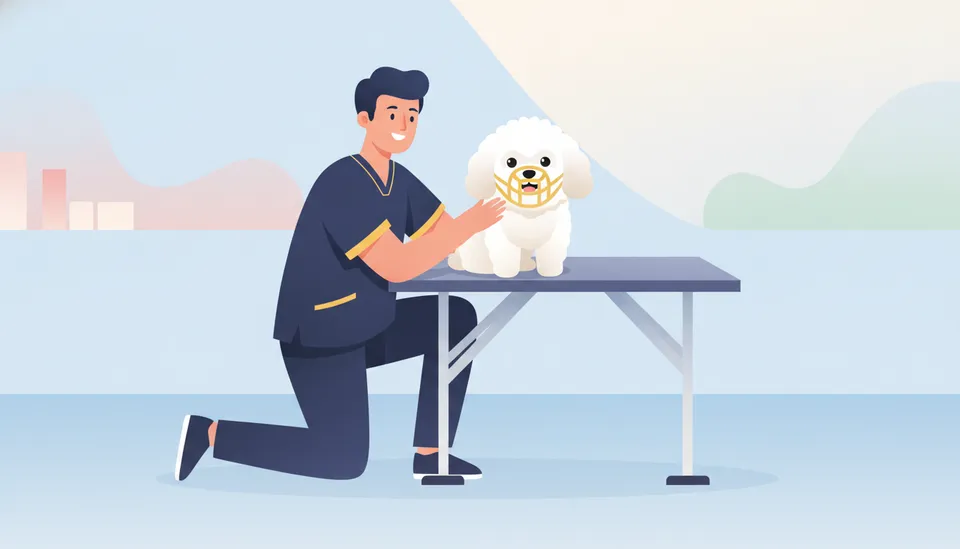
The dog that curls like a shrimp
Nine pounds of chihuahua, handled gently all the way through the bath, quiet on the table, no growl and no lip. Then the clippers go near a back foot and he folds himself in half — groomers describe it as curling “like a shrimp” — and puts a tooth through the web of your hand before you have registered that he moved.
At pickup the owner is cheerful. That’s odd. His last groomer never needed a muzzle.
If you have been grooming longer than a year you have heard that sentence, and it lands badly every time, because it is phrased as a comment about your competence. It almost never is one. A thread on r/doggrooming asking how to respond to it drew dozens of replies, and the groomers in it mostly agreed on one thing: the sentence tells you a lot about the last groomer and almost nothing about you.
This post is how to turn that moment into a policy instead of an argument. It is the handling side of the record you build at drop-off — our 15 check-in questions to ask before every groom is the wider list, and question 8 on it, the bite question, is the one that produces this conversation.
What the sentence actually means
There are four explanations, and groomers argue about which is most common because all four are real.
The owner knows and did not say. The dog has a bite history at the vet, at the last salon, or at home over his feet. The owner has learned that disclosure gets the dog refused, so they stopped disclosing. This is the most common one, and the reason the bite question at check-in has to be asked in a way that makes a “yes” safe to say.
The last groomer did not tell them. Plenty of groomers take a bite, say nothing, bandage up and carry on, because they do not want the conflict at pickup. The owner is then genuinely surprised — and the next groomer walks in blind. This is why the honesty rule at the end of this post matters so much.
The dog knows the other salon and does not know you. New building, new smells, new hands, new dryer. A dog that tolerates a familiar person for ten visits may not tolerate a stranger on the first. That is not a character flaw in anyone.
The dog is having a bad day. Sore ear, sore hip, a long car ride, a thunderstorm last night.
You do not need to work out which one it is. The policy has to work in all four cases.
Write the policy before you need it
A muzzle policy improvised at the front desk sounds like an accusation. The same policy, printed and signed at intake, sounds like a procedure. Here is wording you can copy and adjust:
Muzzle and handling policy
Our first priority is finishing your dog’s groom safely, for him and for the person holding the clippers.
We may use a soft muzzle for part or all of a groom if your dog snaps, bites, or becomes distressed during handling — most often for nails, feet, face or sanitary work. A muzzle does not hurt your dog, does not mean we think he is a bad dog, and does not change your price unless the work takes significantly longer.
If your dog has ever bitten or snapped at a person — here, at the vet, at another salon or at home — please tell us when you book. We will plan for it. We refuse far more dogs for undisclosed bite histories than for disclosed ones.
Once a dog has bitten or attempted to bite in our salon, we will use a muzzle for the same part of the groom at every future visit. We will tell you at the time, and it will be noted on your dog’s record.
If your dog cannot be groomed safely even with a muzzle, we will stop, call you, and charge for the work completed. We will always tell you exactly what happened.
Three things that wording is doing on purpose. It names the moments a muzzle usually goes on, so it is not a mystery. It makes the muzzle permanent once there is a bite history, so no groomer in your salon has to relitigate it with the owner. And it says out loud that disclosure is the safe choice, because the real problem you are trying to fix is the owner who hides the history.
Put it in the same place as the rest of your terms — our guide to what a good pet service agreement looks like covers where a handling clause sits alongside the matting and photo clauses, and why a signature at intake is worth more than a sign on the wall.
Try it with your numbers
What are no-shows costing you?
Drag two sliders. Packyard's calculator uses your groom price and your no-show count, not an industry average.
Try these before the muzzle
A muzzle is the right call for a dog who means it. For a dog who is frightened rather than committed, there are gentler steps worth taking first, all of them suggested by working groomers:
- Tap before you touch. Two fingers on the shoulder before the hand arrives, every time you change what you are doing. Dogs bite the thing that appears without warning.
- A groomer’s helper or a second pair of hands for the thirty seconds that are actually the problem, usually nails.
- A cone for a very small dog, which some handlers prefer over a muzzle for face and foot work on a ten-pound dog.
- A quiet slot. First appointment of the day or last, blinds down, no dryer running next to him, nobody walking past. For some dogs this is the whole fix.
- Split the groom. Bath and dry today, nails on a separate short visit next week.
Worth knowing: for a lot of dogs the muzzle itself turns out to be calming. Groomers describe it as a security blanket — the dog stops being asked to decide whether to bite, and settles.
The script at drop-off, and the one at pickup
When you already know it is going on:
“He was unhappy about his feet last time, so I’ll pop a soft muzzle on for the nails and the sanitary. It’s two minutes of the groom and it keeps him from making a decision he regrets. Everything else is as usual.”
When the owner pushes back with the sentence:
“I can’t speak to how he’s done before, only how he did today.”
That one line, said evenly, ends most of these conversations. It does not accuse the owner of lying and it does not accuse the last groomer of anything. It is also simply true.
If they keep going:
“He’s welcome here, and I’m happy to keep grooming him — this is just how we’ll do his feet. If you’d rather he went back to the groomer who managed without one, I completely understand.”
Groomers report that offering the door is the point at which owners backpedal, usually with a partial admission: well, he was a bit snippy for nails. There it is.
When the owner asks for the muzzle themselves, which happens more than you would expect — one owner of a big guarding breed asked for it specifically so the dog would not end up with a “black mark” — take it gracefully and note it as the owner’s standing preference, not as a bite history. They are not the same record.
Tell the truth about every bite
The single most important rule here, and the one most often broken: the owner is told, in plain words, every time. Not “he was a bit of a handful.” A bite, where, and what you did about it.
Softening the news feels kind at the desk, and it is how the next groomer ends up bitten. The chain of information about a dog runs through owners — to the next salon, to the vet tech, to the boarding kennel — and every groomer who stays quiet to avoid an awkward pickup breaks it for everyone downstream. The salon that hears “his last groomer never needed a muzzle” is standing at the end of a chain somebody else broke.
Say it like this:
“I want you to know exactly what happened — he caught my hand when I picked up his back foot. He broke skin, I’ve cleaned it, and I’m fine. He finished the groom in a muzzle and he was much happier with it on. It’s going on his record so whoever has him next does the feet the same way.”
Flag the dog, not the visit
A muzzle policy fails for a boring reason: the person who knows is not the person who takes the next booking.
The groomer who got bitten remembers for about three months. The front desk never knew. The owner books online at ten at night and the dog arrives at eight the next morning with a brand-new bather, who picks up a back foot. A note in a paper diary, or in last visit’s appointment, is a note nobody reads in time.
What has to be true instead:
| The flag has to appear | So that |
|---|---|
| When the slot is booked | A difficult dog is not offered a brand-new bather or a rushed slot |
| On the appointment | Whoever grooms him today sees it without opening the client file |
| At check-in | The desk can confirm it out loud: “muzzle for his nails, same as last time” |
| On the pet’s record | It carries to the next dog the family brings, and survives staff leaving |
This is the part Packyard is built for. A dog’s profile carries a handling flag — muzzle required, and the note of what it is required for — and the flag surfaces when the appointment is booked, on the groomer’s view of the day, and again at check-in. It is attached to the pet, not to a single appointment, so it does not expire when the groomer who wrote it leaves. If you want to see it against your own client list, start with Packyard for pet grooming.
For what to write in the note itself, so it is useful and not just alarming, see how top groomers track pet behaviour notes that actually get used. “Use caution” is not a note. “Muzzle for back feet, fine for everything else, tap his shoulder before you lift” is.
When the muzzle is not enough
A muzzle makes a dog safe to finish. It does not make every dog worth taking, and that is a separate decision — who in your salon handles a dog with a bite history, whether a junior groomer is ever given one, and what you charge for the extra time and the second pair of hands.
The short version: name the groomer who takes difficult dogs rather than passing the dog around, do not hand a biter to your newest hire because nobody else wants him, and price the slot for the time it genuinely takes. A dog that needs two people and ninety minutes is not a standard groom.
The policy in four lines
If you take nothing else from this:
- Write it down and have it signed at intake, so the muzzle is a procedure, not a judgement.
- Once a dog has a bite history here, the muzzle is permanent for that part of the groom. No negotiation, no case-by-case.
- Flag the dog, not the visit, and make the flag appear at booking, on the appointment and at check-in.
- Tell the owner the truth about every bite, every time, even when it is uncomfortable.
The next groomer gets to find out before the dog is on their table instead of after. That is the whole point.