
How to Raise Your Grooming Prices (and Announce It Without Losing Clients)
How to raise grooming prices for January 1: work out the new price from your hourly costs, give 30 days of notice in writing, and handle card fees, loyal clients and pushback. With the announcement text, a counter sign and a timeline.
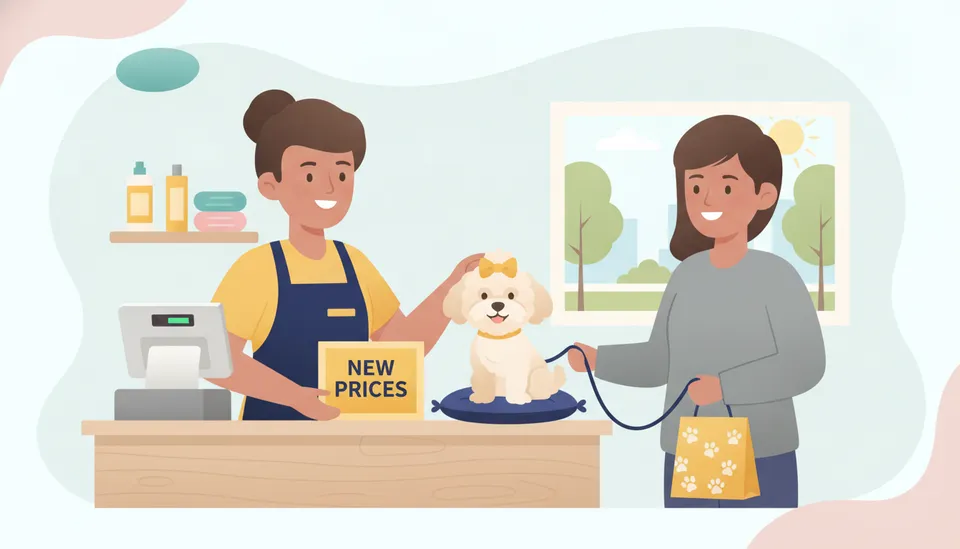
A rural salon is one year old. Her card processor has just put her rate up to 3.4% plus 30 cents a swipe, and her small-dog price is still the $55 she opened with. She has written “$70 from January 1” on a sign, and it has been sitting face down behind the till for a week.
To raise your grooming prices without losing the clients you want, pick a date, set the new price from what an hour of your table time has to earn, and tell every client in writing at least 30 days ahead. Give them the date, the new price for their dog and one honest reason, and don’t apologize. A few price shoppers will leave. Most regulars stay, because they come for the groomer, not the number.
January 1 is the easiest date in the grooming year to do this. Clients expect prices to change with the new year, and a 30-day notice lands in the first days of December, when your book is full and confidence is high.
How do you know it’s time to raise prices?
Most groomers raise prices too late, not too early. Any one of these is a reason to look at your numbers:
- You’re booked out two weeks or more. Demand is telling you the price is low.
- Your costs went up. Card fees, shampoo, blades, rent, insurance.
- You haven’t raised in a year or more. Costs have moved even if you haven’t noticed.
- Some dogs earn less per hour than others. Doodles and big double coats are the usual suspects.
- You dread certain grooms. That’s often a price problem, not a dog problem.
How much should you raise grooming prices?
Start from your hourly target, not from the salon down the road. Work out what an hour of table time needs to earn, time a few real grooms, and check each price against it. The dog grooming price list template walks through that math cell by cell. To see what salons charge by size, coat and region, use the guide to how much to charge for dog grooming.
Then decide between one jump and two steps. Our rural salon’s plan was a big jump: $55 to $70 for small dogs (27%) and $100 to $120 for doodles (20%). In the thread where she asked about it, one client’s view stood out: small, regular increases go down easier than one large one. A groomer in another thread keeps increases to about 15% every six months.
| Plan | Small dog | Doodle | Good for |
|---|---|---|---|
| One jump, January 1 | $55 → $70 | $100 → $120 | Prices far below your target, a full book |
| Two steps | $55 → $62 Jan, $70 July | $100 → $110 Jan, $120 Jul | Many long-time or fixed-income clients |
| Yearly review | +5–10% each January | +5–10% each January | Prices already close to your target |
You don’t have to raise every line by the same amount. Raise hardest where the time is underpriced. A doodle that takes two and a half hours at the same price as a two-hour groom is where the money leaks. Matting and handling belong on the list as their own charges, not in the base price. Matted dog markup covers that.
Card fees: raise prices, surcharge, or switch?
Rising card fees are the most common trigger, and there are four ways to deal with them.
- Build them into your prices. The simplest option, and the one clients notice least. One price, no line on the receipt to argue about.
- Add a card surcharge. Rules differ by state and by card network, and some states restrict surcharges. Check your state’s rules and your processor’s terms before you add one. The salon in our example couldn’t, which is why she’s raising prices instead.
- Offer a cash discount. Some salons post a lower price for cash. It’s treated differently from a surcharge in many places, but check the same rules first.
- Shop your processor. In the same thread, one commenter reported in-person rates closer to 1.7%. Before you pass a fee to clients, make sure you’re not overpaying for it.
When to announce a price increase
Give at least 30 days of notice. Some groomers give six weeks. Whatever you choose, tell clients in more than one place, because nobody reads everything.
For a January 1 increase:
| When | What to do |
|---|---|
| End of November | Decide the new prices. Update your price list, but don’t publish it yet |
| December 1–3 | Send the text or email. Put the sign up at the counter |
| Every December checkout | Mention it once, in person, and offer to pre-book |
| Mid-December | Update your booking page and Google listing with the January prices |
| January 1 | New prices start. No exceptions you haven’t planned |
Announcing in December has one more advantage: the increase takes effect in January, the quietest month of the year. The January slow-season plan suggests sending price and policy changes together, so clients get one message, not three. If the late-summer slump hit you hard this year, the slow-season guide explains why a quiet month is a bad time to raise prices but a good time to plan the increase.
The announcement text and counter sign
Keep it short. Long letters read like apologies, and apologies invite bargaining. When the salon has changed hands, don’t blame the previous owner. Just set the new prices.
The text or email (copy and edit):
Hi [Name], a note from [Business]. From January 1, our grooming prices are changing. [Dog]‘s [full groom] will be $[new], up from $[old]. We’re adjusting prices so we can keep giving [Dog] the same time and care on every visit. Appointments booked for before January 1 stay at today’s price. Any questions, just reply. Thank you for trusting us with [Dog].
The counter sign:
New prices from January 1
Our prices are changing on January 1 so we can keep giving every dog the time and care they deserve. Ask us for your dog’s new price, or see our price list at [booking page].
Thank you for being part of [Business].
Three things do the work: a firm date, the exact price for their dog and one honest reason. Mobile groomers send the same message. If you’re also adding or changing a travel fee, put both in one text. Mobile grooming prices and travel fees covers how to set the fee.
How to soften it for loyal clients
You can make the increase easier without discounting forever.
- Pre-book at today’s price. Let clients book one or two visits before January 1 at the current rate. It fills December and early January, and it feels generous. In Packyard, changing a service’s price can change the total of visits already booked with it, so give those appointments a custom price before you update the menu.
- Grandfather with an end date. If you keep long-time clients at the old price, say until when: “your price stays the same until July 1.” Grandfathering with no end date becomes a two-tier price list you can never fix.
- Offer a cheaper tier. A bath and tidy gives a client on a fixed income a way to stay. That’s better than a quiet discount you’ll resent.
- Suggest a different interval. For a senior client watching money, a shorter interval with a smaller service can cost about the same per month as before.
What to say when a client pushes back
Most pushback is a one-off comment at the counter. Answer it once, calmly, and move on.
“It just keeps going up.” In one thread, a 5-week standing client said exactly this. Her price hadn’t changed in two years. Say: “It’s the first change in two years. Costs have gone up, and I want to keep giving her the same groom.”
“My last groomer only charged $50.” One groomer’s answer is a smile and “Wow, what a great deal.” Don’t argue, and don’t match it.
“Can you keep me at the old price?” “I can book your next visit before January 1 at today’s price. After that, it’s the new price for everyone.”
“I’ll have to go somewhere cheaper.” “I understand. If it doesn’t work out, we’d love to see her again.”
Accept that some clients will leave
Some will, and that’s part of the plan. Do the math before you worry about it. Say you groom 100 small dogs a month at $55, which is $5,500. Raise to $70 and lose 15 of those clients, and 85 dogs bring in $5,950. That’s more money for 15 fewer grooms.
The clients who leave over price are often the same ones who haggle, complain about time and skip appointments. After one groomer started doodles at $150, she said her doodle complainers and hagglers all disappeared. Her advice was to raise again whenever you’re fully booked. If a client is still a problem after the increase, the next step is a different conversation.
The price increase checklist
- Work out your hourly target and time a few real grooms
- Pick the new prices, and decide on one jump or two steps
- Decide how you’ll handle card fees
- Choose the date: January 1 is the easiest
- Write the text and the counter sign
- Announce at least 30 days ahead, in writing and at the counter
- Give pre-booked visits at the old rate a custom price before changing the menu
- Update your price list, booking page and Google listing before the date
- Write down your answers to the four pushback lines
- Put a date in your calendar to review prices again in six months
- Dog grooming price list template: size-and-coat tables and the hourly check.
- Matted dog markup: charging for matting without the argument.
Weekly, from Himani
The Saturday note
One idea a week for getting clients, keeping them and running the day. Short enough to read between dogs.
If you want the reminder texts, booking page and no-show rules in posts like this one to run on their own, that is what we built Packyard for. 30 days free.