
Mobile Dog Grooming Van Cost: Buy New, Buy Used or Build Your Own
What a mobile grooming van really costs in 2026. New turnkey vans, used vans, cargo van conversions and trailers, plus the water, power and heat decisions that make or break your day.

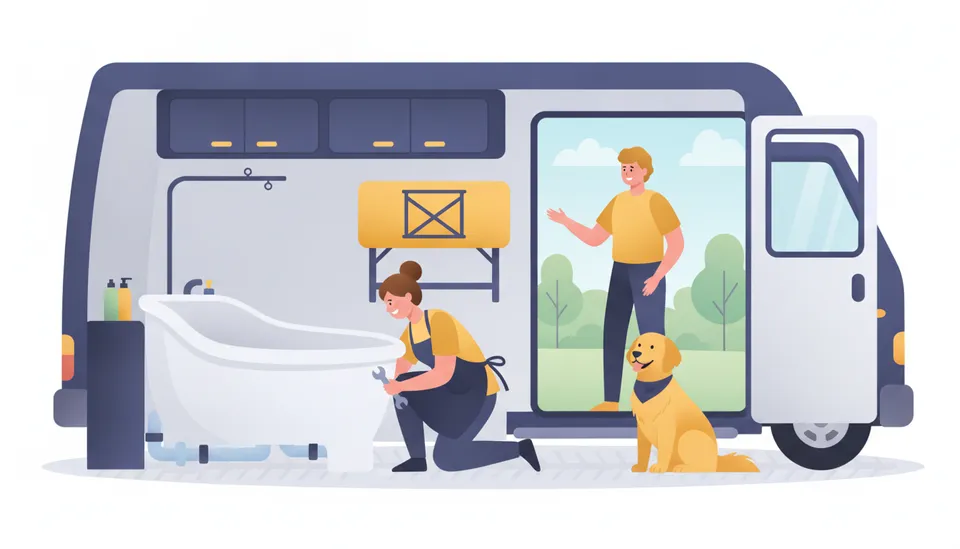
The van is the business
It’s a Saturday in March. Jen has been grooming in salons for nine years and has just put a deposit on a used grooming van she found two states away. The listing said “fully equipped, ready to work”. The engine is fine. What the listing didn’t say is that the water heater is dead, the grey tank has a crack, and the generator needs a $900 service before it will run a dryer for more than ten minutes. She groomed her first dog three weeks and $2,400 later than she planned.
Jen’s van still turned into a good business. But the van is 70 to 85% of what it costs to start mobile grooming, and the mistakes people make on the van are the expensive ones. This page covers the three ways to get a van, what each really costs, and the systems inside it that decide how your days go.
If you haven’t read the full guide to starting a mobile dog grooming business, start there for the whole picture.
The three ways to get a grooming van
| Route | Typical cost | Time to first groom | Best for |
|---|---|---|---|
| New turnkey van from a builder | $100,000 to $160,000+ | 2 to 6 months (build queue) | Groomers with a full client list already, or good financing and a plan to add vans |
| Used turnkey van | $35,000 to $75,000 | 2 to 6 weeks | Most first-time mobile groomers |
| Cargo van plus your own buildout | $35,000 to $80,000 | 2 to 4 months | Groomers with a fabricator, a partner who builds, or time and patience |
| Grooming trailer (new or used) | $20,000 to $60,000 plus a tow vehicle | 2 weeks to 3 months | Lower budgets, rural routes, anyone who already owns a truck |
New turnkey van
The established builders (Wag’n Tails, Hanvey, Mobile Grooming World, Gryphon and others) sell a finished van on a Ford Transit, Mercedes Sprinter or Ram ProMaster chassis with a tub, hydraulic or electric table, dryer, water tanks, heating, air conditioning and a power system. Many hold upfitter certifications with the chassis maker, so the vehicle warranty stays intact.
You get a warranty, financing or leasing through the builder, resale value, and the week it arrives you can groom. You also get a monthly payment of $1,500 to $2,500 for five to seven years. On a solo route doing four dogs a day, that payment is 20 to 30% of your revenue before fuel. It works if you already have a client list waiting. It’s hard if you’re starting from zero.
Used turnkey van
This is where most people should start. Vans come up for sale when a groomer retires, goes back to a salon, or upgrades. Prices run $35,000 to $75,000 depending on age, mileage and what’s inside. Mobile grooming boomed after 2020, so there are a lot of five-to-seven-year-old vans on the market now.
The engine and transmission matter, but they’re not where used vans go wrong. The grooming systems are. Use the inspection checklist below before you hand over money.
Cargo van plus buildout
A used high-roof Ford Transit or Ram ProMaster in good mechanical shape is $15,000 to $30,000. A new one before conversion is $38,000 to $52,000. The buildout (tub, table, dryer, tanks, pump, water heater, power system, cabinets, flooring, lighting) is $15,000 to $50,000 depending on how much you do yourself and what you buy new.
This is the cheapest way in if you or someone close to you can build. It’s the slowest, and the thing that catches people is the power and plumbing. A tub and a table are furniture. A system that gives you hot water and 2,000 watts of dryer at 2pm in July is engineering. If you go this route, buy the power system from a specialist and build the cabinets yourself, not the other way round.
Trailer
A grooming trailer costs less than a van conversion, and if your tow vehicle breaks down you hitch the trailer to another one and keep working. You can also leave it parked and use the truck for other things. The trade-offs are reversing into tight driveways, parking on narrow streets, and needing a vehicle rated to tow it. Trailers suit rural and suburban routes with space. They’re hard in dense urban areas.
The three systems that decide your day
Whatever van you buy, these are what you’re really buying. Ask about each one before you ask about the mileage.
Water
Fresh water sets how many dogs you can do before you refill. Grey water sets whether you’re legal.
- Fresh tank. Most vans carry 50 to 100 gallons. A medium dog bath uses 8 to 12 gallons. A 50-gallon tank does 4 to 5 medium dogs. A 100-gallon tank does a full day. Bigger tanks mean more weight, which matters for the chassis rating and your fuel.
- Hook-up. Some vans let you connect to the client’s outside tap and skip the tank. Useful, but don’t count on it. Taps are off in winter and some clients don’t have one.
- Grey tank. Everything that goes down the tub drain goes here. It needs to be at least as big as your fresh tank in practice, because hair and shampoo take up room and you don’t want to be looking for somewhere to empty it at 1pm. Where you can legally empty it varies by city. Many groomers empty at home into a sanitary sewer connection. Never empty it into a storm drain. Ask your city before you buy. Licences, permits and insurance for mobile groomers has the questions to ask.
- Water heater. Tankless propane heaters are the common choice. Check it works, check the propane locker is vented, and check when it was last serviced.
Power
A high-velocity dryer pulls 1,500 to 2,500 watts. Clippers, lights, the water pump and the table add more. You need a power source that runs all of that for six to eight hours.
| Option | Up-front cost | Running cost | What it’s like |
|---|---|---|---|
| Petrol or diesel generator | Lowest | Fuel, oil changes, servicing, parts | Noisy, fumes, neighbours notice, needs maintenance, can fail mid-day |
| Lithium batteries plus inverter | Highest | Charging overnight, almost no maintenance | Silent, no exhaust, 10 to 12 hours per charge on current systems, batteries last 10 to 15 years |
| Generator plus batteries (hybrid) | Middle | Less fuel, some maintenance | Batteries carry most of the day, generator tops up on long days or in winter |
| Shore power (plug into the client’s house) | Low | None | Only works where the client has an outside outlet and agrees. Backup, not a plan |
The trend is clear. In 2026 most new builds from the big builders are inverter and lithium systems, some with no generator at all. Battery systems cost more up front, and builders claim savings of several thousand dollars a year in fuel and maintenance against a generator. For a used van, a working generator is fine to start. Budget to replace it with batteries when it dies.
Heat and cooling
A wet dog in a van in January needs heat. A groomer in a van in Texas in July needs air conditioning. Check both work. Propane furnaces and roof air conditioners are standard. A van without working climate control isn’t a grooming van for half the year.
Used van inspection checklist
Take this with you. If the seller won’t let you run water and power for 20 minutes, walk away.
- Fill the fresh tank and run the tub for ten minutes. Check pressure and look for leaks under the floor and behind the cabinets.
- Run hot water. Note how long the heater takes and whether it holds temperature.
- Check the grey tank for cracks and smell. Ask where the seller empties it.
- Start the generator or inverter and run the dryer on full for 15 minutes. Watch for cut-outs.
- Ask for the generator’s hours and service history. Over 2,000 hours without a rebuild is a cost coming.
- If lithium batteries, ask the age and brand. Check the inverter output rating against your dryer.
- Run the heater and the air conditioner, whatever the weather.
- Lift the table up and down with weight on it. Hydraulic tables leak. Electric tables have motors that fail.
- Look at the floor around the tub for soft spots. Water damage under vinyl is the most expensive thing to find late.
- Check the propane locker is sealed from the cabin and vented outside.
- Check the cab-to-work-area bulkhead. You want to be able to lock yourself in with a dog.
- Standard vehicle check: tyres, brakes, rust underneath, service history, mileage against the age.
- Ask why they’re selling. Retiring is a good answer. “The route didn’t work” tells you something about the area, not the van.
Monthly cost of owning the van
New mobile groomers budget for the payment and forget the rest. Here’s a realistic month for a used van.
| Monthly | |
|---|---|
| Loan payment on a $50,000 van over 5 years | $950 to $1,100 |
| Commercial auto insurance | $200 to $300 |
| Fuel (vehicle and generator, 20 working days, tight zones) | $350 to $600 |
| Propane | $40 to $80 |
| Maintenance and repair reserve | $250 to $400 |
| Wrap, lighting and small repairs amortised | $50 to $100 |
| Total | $1,840 to $2,580 |
A new turnkey van roughly doubles the first line. The repair reserve isn’t optional. Set it aside every month, in a separate account, from the first month. The one week your van is in the shop is the week you’ll be glad you did.
The fuel line is where your service area shows up. Groomers who take every job across town spend twice this on fuel and lose an appointment a day to driving. Setting your service area and planning routes is how you keep this number down.
Financing the van
Four common routes:
- Builder financing or lease. Available on new vans and sometimes used ones from the same builder. Easiest approval, highest total cost. Some builders offer deferred first payments so you can earn before you pay.
- SBA loan. Lower rates, more paperwork, usually needs a business plan and some time trading. Better for a second van than a first.
- Bank or credit union vehicle loan. Works for a used van if the lender will treat it as a commercial vehicle. Cheaper than builder financing.
- Cash plus a smaller loan. The cheapest van is the one you don’t pay interest on. Many first-time mobile groomers buy a $35,000 to $45,000 used van with savings plus a small loan and upgrade in year three.
Whichever you choose, run the payment against four dogs a day, not six. If the business only works at six, it doesn’t work.
What to track from day one
Keep a mileage log from the first drive. The IRS business standard mileage rate is more than 70 cents a mile in 2026 (check irs.gov for the current figure), and business miles between stops can be deducted. Ask your tax preparer whether the standard rate or actual expenses works better for a van. Groomers who track it from day one claim thousands more than groomers who try to reconstruct it in April. Packyard keeps a mileage log per van with an odometer reading at each stop and exports it as a CSV at tax time, which is one less spreadsheet. Track fuel, propane and repairs by van too, so when you add a second van you know what each one costs to run.
Then put the van to work. Pricing and travel fees for mobile grooming covers how to charge enough to pay for it.
Weekly, from Himani
The Saturday note
One idea a week for getting clients, keeping them and running the day. Short enough to read between dogs.
If you want the reminder texts, booking page and no-show rules in posts like this one to run on their own, that is what we built Packyard for. 30 days free.