· Packyard Team · Knowledge Base · 10 min read
What Does "Light Trim" Mean? A Haircut Consultation Script for Groomers
"Light trim", "puppy cut" and "shave down but leave 2 inches" mean something different to every client. Here is a 5-step consultation script that turns vague words into lengths you can actually cut — and a record you can groom from next time.
“Just a light trim”
A ten-month-old golden retriever comes in. First groom with you. The owner wants “a light trim.”
So you start offering: feet tidied, the fur between the pads taken out, the feathers on the back legs shaped, the wispy bits under the tail, the ears. The owner nods along and then says it again — “just a light trim.” You try once more, naming a specific thing on a specific part of the dog. “Yeah, a light trim.” Then, “how much is it?”
That exchange shows up on r/doggrooming regularly, and the replies always split into the same two camps: groomers who have a script for it, and groomers who are still having the argument at pickup. Because the problem is not that the owner is being difficult. The problem is that “light trim” is a feeling, not an instruction, and the only person in the room who can convert a feeling into a blade number is you.
This post is the conversion. It is a five-step consultation you can run at the desk in three or four minutes, plus the scripts for the clients who resist it. It pairs with the 15 questions to ask at check-in — same moment at the front desk, different half of the conversation. That post covers health and handling. This one covers the haircut.
Why the words fail
Every vague request is vague in its own way, and each one needs a different handle.
“Light trim.” Means “I don’t want him to look different,” which is not the same as “don’t cut anything.” Usually the owner wants the dog tidier without looking shorn.
“Puppy cut.” Means nothing, and means it very confidently. Most owners picture the dog they brought home at twelve weeks.
“Shave down.” Ticked on the form, with “leave 2 inches” written next to it in the notes box. One groomer gets this every single month from the same client, does a #4 all over, and the owner is delighted — on a dog that has never had two inches of coat in its life.
“Short short.” Usually means a 5/8” comb. Occasionally means a #7. The gap between those two is the gap between a happy client and a shouting match.
“Whatever you think.” Either real trust or a loaded gun, and you cannot tell which from the sentence.
The common thread: owners do not have the vocabulary, and most of them have no idea what a measurement looks like on a coat. “Most people don’t know what an inch looks like, especially on curly hair” is the single most useful sentence in this whole subject. So stop asking them to use words.
The 5-step consultation script
Step 1. Put your hands in the coat before you ask anything
Lift the coat on the shoulder. Run a comb through the hind leg. Feel behind the ears and in the armpits. Do it while the owner is standing there watching you.
This does two things. It tells you what is actually possible — a matted doodle has already made most of the decisions for you — and it changes the owner’s expectations before they have said a number out loud. People who watch a comb stop dead behind an ear are much easier to talk to about length.
If the coat is tight to the skin in places, that conversation happens now, not after the clippers are running.
Step 2. Break the phrase, don’t accept it
When the owner uses one of the stock phrases, don’t repeat it back and don’t argue with it. Take it apart with a question they can answer.
For “puppy cut”:
“Puppies are born with their hair all the same length. Do you want one length all over? Face too? Tail? The whole dog?”
For “shave down, leave two inches”:
“Two inches is about this” — hold up your index finger — “which is longer than what he’s carrying right now. Do you want him about half the length he is, or really short?”
For “light trim” on a long-coated dog, offer the default and let them edit it:
“On a coat like his, a light trim for me means feet, tail, ears, and the wispy bits under the tail, on the skirt and on the chest. Body stays the length it is. Does that sound like what you pictured, or shorter?”
Giving them something concrete to react to is far more productive than asking them to invent a description. Almost every owner can say “yes, but shorter on the body.” Almost none can say “a #5 on the body with a 5/8 head.”
Step 3. Walk the four zones, in order
Body, head and face, ears, tail. Say each one out loud, get an answer, move on.
- Body. Short like a lab, half the length it is now, or just tidied? Offer a reference they know: “short like a lab’s coat” is understood by almost everyone.
- Head and face. This is where the complaints come from. Owners forgive a short body. They do not forgive a short head. Ask if they want it round, shorter and tidier, or left long and just cleaned up around the eyes.
- Ears. Long, shortened, blended into the head, or taken off? Ear tufts need naming specifically, because “head” and “ears” are one thing to the owner and two jobs to you.
- Tail. Tidied, same length as the body, or shaved? Three different dogs.
Feet and sanitary come out of your service definition rather than the consultation, as long as your menu actually says what each service includes. If clients regularly argue about what a bath and tidy covers, the fix is upstream of this conversation.
Step 4. Show the length, never just say it
Numbers are your language, not theirs. Translate in both directions.
Use your hands. One finger’s width is roughly half an inch. From the middle knuckle to the top knuckle of your index finger is roughly an inch. Hold it against the dog’s coat.
Point at the measurement. Put your finger on the half-inch mark on the comb or the ruler and ask one question: “Too long, or too short?” You will get a straight answer in two seconds.
Borrow a reference they already own. “This is a number one for a man” works for a #7 with almost every client who has ever been to a barber. “That’ll look like a buzz cut — is that what you want?” is a fair warning, not a sales objection.
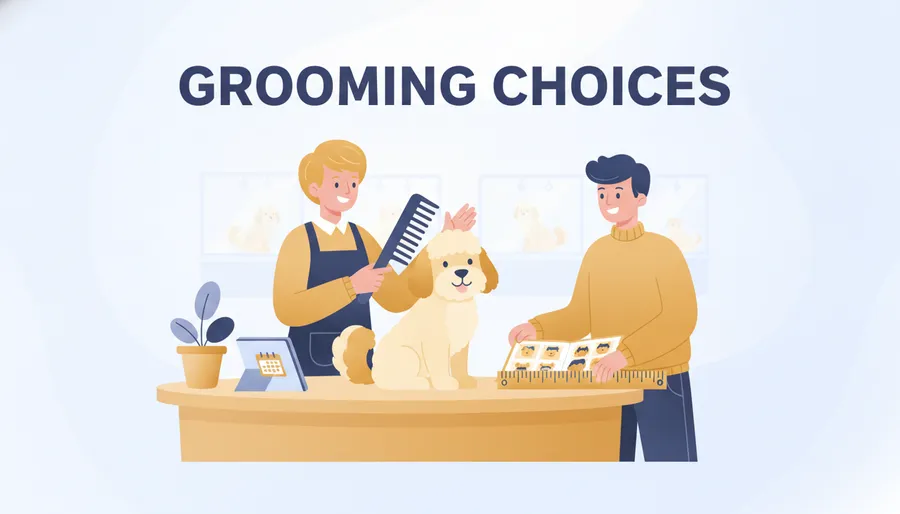
Keep photos at the desk. Printed pictures of the trims you do most often, in a folder you can point at. Better still, ask for a photo of their own dog after a groom they liked. Their dog’s old haircut beats a stranger’s dog every time, because the coat in the photo is the coat on your table.
One groomer’s trick for the vague ones: ask “what would you do?”, and when they shrug, offer “a number ten strip.” The suggestion is deliberately extreme, and it reliably produces an actual opinion.
A chart of blade and comb numbers next to how each one looks and feels is worth having laminated at the desk for this step.
Step 5. Say it back, then write it down
Repeat the whole thing as one sentence while the owner is still in front of you:
“So: half an inch on the body, head and ears left long and just cleaned up around the eyes, tail tidied not shortened, feet rounded. And it’s $85 unless we find knots that need extra time, in which case I’ll call you. Is that right?”
Get a yes. On a first visit, or on any short cut, get it in writing — on the service agreement, the intake form or the booking confirmation. If the owner is asking you to take a double-coated dog short, that is a waiver conversation, because a shaved husky or golden may not come back the same.
Then save it to the dog’s record, in the same words, before the dog goes to the back.
Three clients who resist the script
“Do whatever you think.” Groomers genuinely disagree about this one. Some read it as trust and enjoy it. Others treat it as a trap, because “cute” is subjective and you are the one who will be wrong. The useful middle is to make your own taste explicit and let them veto it: “What I find cute on this coat is short ears and a round head — is that OK with you?” Said cheerfully, it almost always produces either a yes you can rely on or the preference they were sitting on.
“It comes with a trim, though, right?” The short-coated mutt whose owner spends ten minutes insisting on a trim and leaves angry because there was nothing to trim. The way out is to name the service by what you will do, not by what it is called: “On his coat the bath package is a bath, blow-dry, nails, ears and a sanitary tidy. There’s no length to take off — if I trim his back he’ll have lines in it.”
The reference-photo client. A shih tzu owner holding a photo of a poodle’s clean sharp lines, or an AI picture of a dog in a tidier coat than any real dog has. Coat texture decides what is achievable, and the script is: “Her coat texture is different from the photo, so I can go in that direction, but I can’t promise that result.” Then offer the achievable piece of it — poodle feet on the shih tzu, for instance.
Where the answer has to live
A consultation you run brilliantly and then lose is a consultation you will run again in eight weeks. This is the part that quietly breaks on paper: the sheet goes in a folder, the groomer who did the consultation is off that day, and the dog comes back to “same as last time” with nobody able to say what last time was.
Packyard keeps the haircut record on the pet, not on a sheet — blade and comb numbers by zone, what the owner asked for in their own words, what they liked or did not like at pickup, and photos from the last visit attached to the appointment. The next person to open the booking sees the specifics before the dog arrives, which turns “same as last time” from a guess into an instruction. If you are grooming from a paper book today, moving to online booking is where that starts, and Packyard for pet grooming is the short version of what it looks like.
What to actually write after the groom is its own discipline.
Copy this: the desk script
- Hands in the coat. Comb the shoulder, hind leg, behind the ears. Say what you find out loud.
- Break the phrase. “One length all over? Face too? Tail?” / “Two inches is about this — longer than he is now.”
- Four zones. Body → head and face → ears → tail. One question each.
- Show, don’t say. Finger width ≈ ½”. Point at the mark: “too long or too short?” “This is a number one for a man.” Photos of your own work at the desk.
- Say it back and save it. Full sentence, price with the “unless”, yes from the owner, written to the dog’s profile before he goes to the back.
For short cuts on double coats: waiver, signed, every time.