· Knowledge Base · 11 min read
Grooming Business Models: Complete Guide for 2026
Compare the four grooming business models — salon, mobile, at-home, and house-call. Covers startup costs, profitability, daily operations, and how to choose the right fit.
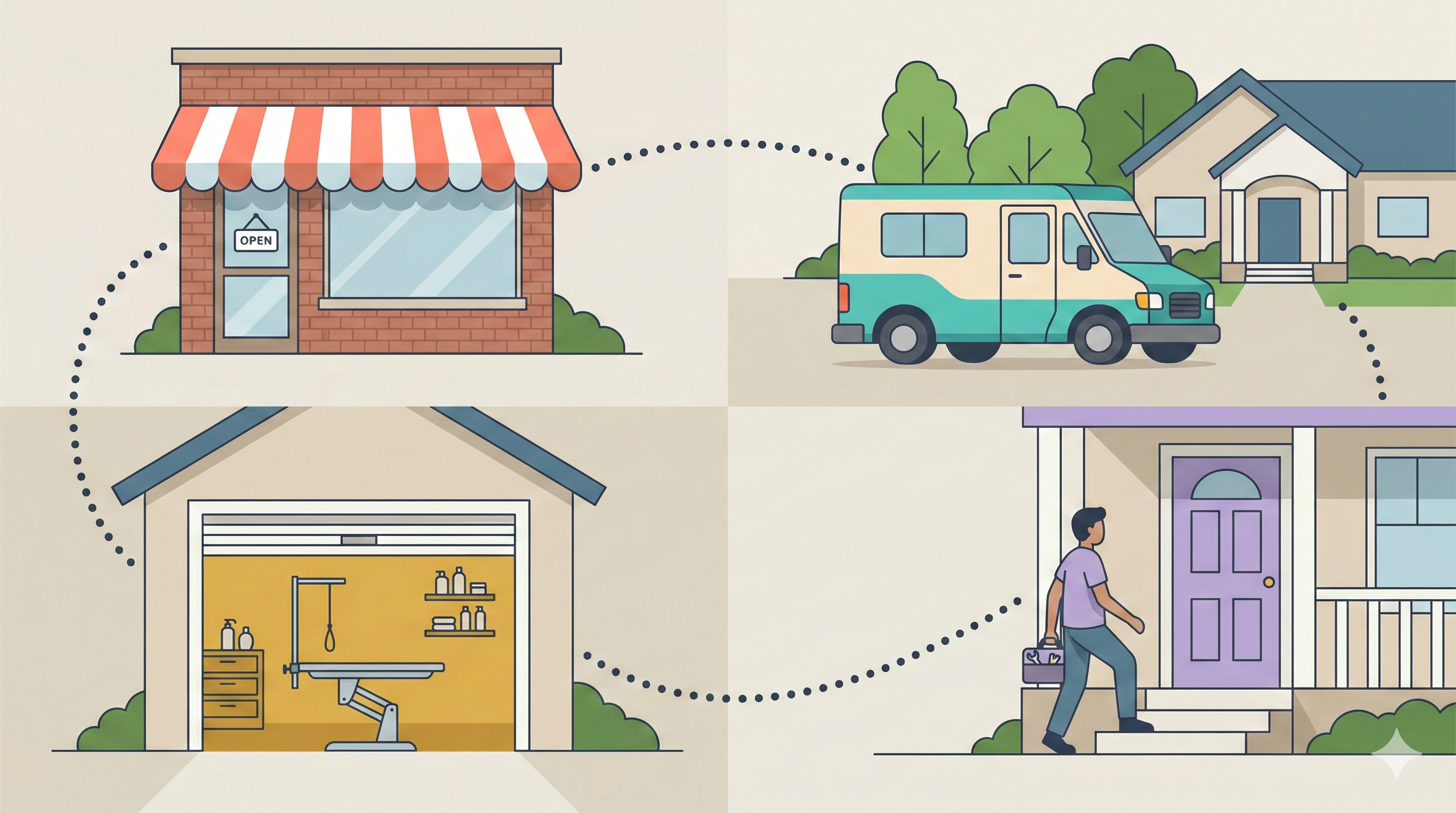
A grooming business model determines where you work, how clients find you, and what your overhead looks like every month. The four primary options—brick-and-mortar salons, mobile grooming, at-home operations, and house-call services—each carry different startup costs, revenue ceilings, and scheduling demands.
Pick the wrong model for your budget or lifestyle, and you’ll spend years fighting a structure that works against you. This guide breaks down each model’s pros, cons, and operational realities so you can choose the one that actually fits.
What is a grooming business model
A grooming business model determines where you work, how clients find you, what your overhead looks like, and how your daily schedule runs. The four primary models are brick-and-mortar salons, mobile grooming, at-home operations, and house-call services. Each one carries different startup costs, different revenue potential, and different scheduling demands.
Your choice here shapes everything from how many dogs you can groom per day to whether you’re paying rent or a vehicle loan. Pick a model that doesn’t fit your budget or lifestyle, and you’ll spend years fighting against a structure that works against you.
Four types of pet grooming business models
Most guides mention three models, but there’s actually a fourth worth knowing. The differences between them affect your daily workflow, your income ceiling, and the systems you’ll rely on to stay organized.
Brick-and-mortar grooming salons
A brick-and-mortar salon is a fixed-location shop with dedicated grooming stations, bathing areas, and often a lobby or retail section. This model supports walk-in traffic, high client volume, and team expansion since multiple groomers can work at the same time.
The trade-off is that you’re locked into a lease. You pay rent whether chairs are full or empty.
Mobile grooming businesses
Mobile grooming means operating from a fully-equipped van or trailer that travels directly to clients. You eliminate the storefront, but you’re now managing a vehicle that requires maintenance, fuel, and route planning.
Clients typically pay a 10–30% premium for the convenience. You trade volume for higher per-service pricing.
At-home grooming operations
Running a grooming business from a dedicated space in your residence keeps startup costs low and eliminates commuting. Many solo groomers start here while testing whether the business works for them.
Zoning laws vary by municipality, though. Some residential areas prohibit commercial activity entirely, so check before you invest in equipment.
House-call grooming services
House-call grooming differs from mobile grooming in one key way: instead of a self-contained van, you travel to client homes with portable equipment and use their space. This keeps vehicle costs minimal but limits your control over the grooming environment.
You’re typically limited to smaller dogs and clients with suitable bathing areas.
Pros and cons of each grooming business model
Every model involves trade-offs. The question isn’t which is “best” but which fits your situation right now.
| Model | Best For | Biggest Challenge |
|---|---|---|
| Brick-and-Mortar | High volume, team growth, professional image | Highest overhead, lease commitment |
| Mobile | Premium pricing, client convenience | Vehicle costs, travel time reduces capacity |
| At-Home | Low startup, flexible hours | Zoning restrictions, limited growth |
| House-Call | Minimal investment, testing the market | No control over workspace, small dogs only |
Brick-and-mortar advantages and challenges
A salon lets you groom more dogs per day because multiple groomers can work simultaneously. You build a professional image, attract walk-ins, and can add retail revenue.
On the other hand, you’re paying rent, utilities, and buildout costs whether you have appointments or not. One slow month hits harder when overhead runs high—seasonal dips can cut revenue by 25% during fall and winter.
Mobile grooming advantages and challenges
Mobile groomers often charge more per service because clients value the convenience. No rent means more revenue stays as profit.
Yet travel time between appointments cuts into your daily capacity. A salon groomer might finish 8 dogs while a mobile groomer doing the same quality work might max out at 5 or 6 due to drive time.
At-home grooming advantages and challenges
Your commute is zero. Your overhead is minimal. You can start with a few thousand dollars in equipment and test demand before committing further.
The downside is that work-life boundaries blur when your business is in your house. And if zoning prohibits commercial activity, you’re operating at risk.
House-call advantages and challenges
House-call grooming requires the least equipment investment. A foldable table, portable dryer, and your tools get you started almost immediately.
But you’re dependent on the client’s space. A cramped bathroom with poor lighting makes quality work harder, and you can’t control noise, distractions, or other pets in the home.
How profitable is a pet grooming business
Profitability depends more on your systems than your model. A well-run at-home operation can out-earn a chaotic salon with twice the overhead.
Revenue potential by model
Each model generates revenue differently:
- Brick-and-mortar: Volume-based, with multiple groomers working full schedules
- Mobile: Premium pricing offsets lower volume, so solo mobile groomers often net more per dog
- At-home: Lower overhead means more of each dollar stays as profit, even with fewer appointments
- House-call: Convenience fees compensate for travel, but capacity stays limited
Dogs groomed per day by model
A salon groomer with efficient systems might complete 6 to 10 dogs daily depending on breed mix. Mobile groomers typically handle 4 to 6 due to travel. At-home and house-call groomers fall somewhere in between based on their setup.
The real variable is how much time you lose to scheduling chaos, no-shows, and checkout friction.
Profit margins and break-even timelines
At-home operations often reach profitability within months because startup costs are low. Mobile groomers may take 1 to 2 years to recoup vehicle investment. Brick-and-mortar buildouts can push break-even to 2 to 3 years depending on lease terms and buildout costs.
Margins improve dramatically when you reduce empty appointment slots. A single no-show per day at an $80 average ticket costs you $1,600 per month in lost revenue.
Startup costs for each pet grooming business model
Your budget often determines your starting point. Here’s what to expect at each level.
Low investment for at-home and house-call
Expect $2,000 to $5,000 for essential equipment: a grooming table, high-velocity dryer, clipper set, and basic supplies. This is the entry point for most new groomers testing the business.
Mid-range investment for mobile grooming
A used van conversion runs $20,000 to $40,000. New custom builds can exceed $80,000. Add water systems, generators, and full equipment suites. Vehicle condition and customization drive the variance.
Higher investment for brick-and-mortar
Lease deposits, buildout costs for plumbing, drainage, and HVAC, plus multiple stations, kennels, and retail inventory push startup costs to $75,000 to $150,000. Timeline from signing a lease to opening doors typically runs 3 to 6 months.
Equipment and supplies by model
What you need depends on where you’re working. Here are the essentials for each model.
Salon equipment checklist
- Hydraulic grooming tables
- Professional dryers, both stand and handheld
- Bathing tubs with sprayers
- Clipper sets and blade inventory
- Kennels and crates
- Point-of-sale system
Mobile van setup checklist
- Water tanks for fresh and gray water
- Generator or shore power hookup
- Built-in tub and table
- Climate control system
- Secure storage for tools
At-home and house-call equipment checklist
- Foldable grooming table
- High-velocity dryer
- Portable tub or bathing system
- Tool bag with clippers, shears, and brushes
- Cleaning and sanitation supplies
Licenses and insurance for grooming businesses
Legal requirements vary by model and location. Getting this wrong can shut you down or leave you exposed.
Business licenses and permits by model
Most areas require a general business license regardless of model. Brick-and-mortar salons often need additional permits like health department approval, occupancy permits, and signage permits. Mobile groomers may need vehicle-specific permits in some municipalities.
Zoning and lease considerations
At-home groomers face the biggest zoning risk. Residential zones frequently prohibit commercial activity, and neighbors can report you. For brick-and-mortar, look for leases that explicitly allow pet services, have adequate plumbing access, and include parking for clients.
Insurance coverage requirements
- General liability: Covers client injury on premises or property damage
- Professional liability: Covers grooming-related pet injuries
- Commercial auto: Required for mobile groomers
- Property insurance: Covers equipment and buildout
Revenue models for pet grooming businesses
How you charge matters as much as what you charge. The pricing structure you choose affects cash flow predictability and no-show rates.
Per-service pricing
The standard approach is charging per groom based on breed, coat condition, and services selected. Simple to implement, but income varies week to week based on bookings.
Membership and package pricing
Recurring revenue through prepaid packages or monthly memberships creates predictable income. Clients who’ve already paid are far less likely to no-show because they have skin in the game.
Hybrid pricing strategies
You can combine approaches: memberships for regulars, per-service for occasional clients. Layering in deposits or cards on file protects revenue regardless of which pricing model you use.
How to choose the right grooming business model
There’s no universal answer here. The right model matches your budget, lifestyle, and local market conditions.
Evaluate your budget and startup capital
Start with what you can afford. Limited capital points toward at-home or house-call to get started. You can transition models as you grow, and many successful salon owners started mobile or at-home first.
Match your model to your lifestyle
Consider what you actually want your days to look like:
- Want employees eventually? Brick-and-mortar scales better for team growth
- Hate commuting? At-home eliminates it entirely
- Love driving and independence? Mobile might fit your personality
- Testing the waters? House-call requires minimal commitment upfront
Analyze local demand and competition
Check what’s saturated in your area. If mobile groomers dominate, a salon may differentiate you. If no mobile options exist, there’s opportunity in a market growing at over 7% annually. Local Facebook groups and review sites reveal gaps in service.
Managing daily operations across models
Picking a model is step one. Keeping it profitable is where most groomers struggle, regardless of which model they choose.
Scheduling and appointment flow
Brick-and-mortar can stack multiple groomers on the same schedule. Mobile operations have to account for drive time between stops. Manual scheduling through paper books or basic calendars breaks down as you grow because you end up doing time math in your head for every booking.
Reducing no-shows and last-minute cancellations
A single no-show per day at an $80 average ticket costs $1,600 per month. Preventive systems make a measurable difference:
- Automated reminders: Send confirmations 24 hours and 2 hours before appointments
- Confirmation tracking: Know who’s confirmed versus who hasn’t responded
- Cards on file or deposits: Financial commitment reduces flaking
Grooming-specific software like Packyard handles reminders automatically so they go out without you thinking about it.
Client communication without the personal phone
Texting clients from your personal phone scatters messages across devices and blurs work-life boundaries. Centralized communication tied to appointments means any team member can see history, and you stop fielding booking questions at 10 PM.
Payment processing and checkout
Manual reconciliation wastes time at the end of every day. Tips, taxes, and retail all work better when they sync in one system. If you’re already using Square, look for software with native integration so checkout doesn’t become a separate job.
Software built for grooming business operations
Generic appointment tools weren’t built for grooming workflows. The difference shows up in wasted time and scheduling mistakes.
Grooming-specific calendar and booking
Generic tools fail groomers because they don’t account for service stacking, buffers, cleanup time, or table allocation. A grooming calendar shows every groomer, every table, and every pet at a glance so you stop doing mental math when booking.
Packyard’s calendar is built for grooming workflows, with the ability to block out baths, haircuts, add-ons, and cleanup exactly how your day runs.
Automated reminders and confirmations
The system works like this: automated SMS goes out at 24-hour and 2-hour intervals before appointments. Two-way texting lets clients confirm or reschedule without phone tag. Flag clients who don’t confirm so you can follow up or fill the slot.
Client and pet records in one place
Track pet history, groom notes, photos, behavior flags, allergies, medications, and temperament in one system. Anyone on your team picks up where the last visit left off. Consistency builds client trust and repeat bookings.
Run your grooming business without the chaos
Your business model determines your daily reality, but the right systems keep any model profitable. Whether you’re grooming from a van, your garage, or a full salon, the operational challenges are the same: keeping chairs full, reducing no-shows, and making checkout seamless.
Start with Packyard free. No credit card required, 14-day money-back guarantee. One saved appointment pays for itself.
FAQs about grooming business models
How do I transition from one grooming business model to another?
Test the new model part-time before fully committing. Many groomers add mobile days before opening a salon, or rent a booth in an existing shop before signing their own lease. This approach lets you build clientele and validate demand without burning bridges.
Can I run a hybrid grooming business with both salon and mobile services?
Yes, hybrid operations serve clients who prefer in-shop visits and clients who want at-home convenience. The key is scheduling software that handles both workflows in one calendar. Otherwise you’re managing two separate systems.
What is rule number one for grooming a dog safely?
Never leave a dog unattended on a grooming table or in a dryer. This single rule prevents the most serious grooming accidents. Everything else like muzzles, restraints, and behavior flags supports this core principle.
How do no-show rates differ between mobile and salon grooming?
Mobile grooming typically sees lower no-show rates because clients are home waiting for you. Salon appointments are easier for clients to forget or skip without consequence, which is why automated reminders matter more for fixed-location businesses.
Do mobile groomers need different software than salon groomers?
Look for grooming software that supports both models in one system. If you expand later or offer hybrid services, you won’t have to migrate data or learn new tools. Features like route optimization matter more for mobile while table allocation matters more for salons.