· Packyard Team · Pet Grooming License & Business Requirements · 18 min read
Pet Grooming License & Business Requirements in Texas (2025)
Step-by-step guide to starting a pet grooming business in Texas. Covers permits, licensing, taxes, and compliance.

Pet Grooming License & Business Requirements in Texas (2025): The Complete Guide
Important: Fees, tax rates, and regulations change frequently. This guide reflects requirements as of early 2025. Always verify current requirements with the specific agencies listed before making business decisions. Direct links to official sources are provided throughout.
Starting a pet grooming business in Texas is easier than in most states—but that simplicity can be deceiving.
You’ll often hear:
“Texas doesn’t require a pet groomer license.”
That statement is true, but it hides the real compliance work. Texas regulates grooming as a taxable business activity, not as a licensed profession. The real requirements live in sales tax collection, franchise tax reporting, city permits, and local animal facility licensing—not in a professional grooming credential.
This guide covers storefront salons, home-based groomers, and mobile grooming operations, with specific attention to Texas’s unique tax structure—no state income tax but mandatory sales tax on grooming services—and significant city-by-city variation in animal facility requirements.
Quick Reference: What You Must Do
Required for ALL Grooming Businesses (Regardless of Model)
- Texas sales tax permit (Texas Comptroller)
- Federal EIN (IRS)
- Business structure registration (if LLC or corporation)
- Annual franchise tax filing (even if no tax due)
- Business insurance (general liability, CCC/bailee coverage)
- Business banking account
Model-Specific Requirements
| Requirement | Storefront | Home-Based | Mobile |
|---|---|---|---|
| Zoning approval | Commercial zoning verification | Home occupation permit/approval | Parking/storage location approval |
| City business license | If city requires (varies by city) | If city requires (varies by city) | Each city you operate in |
| City animal facility permit | Often required (varies by city) | Often required (varies by city) | Varies by city |
| Wastewater compliance | Commercial sewer | Residential sewer/septic | Holding tank + disposal plan |
| Facility inspection | Often required | Depends on city | Depends on city |
Bottom line: Sales tax registration is required for everyone. City permits and animal facility licenses vary dramatically by location.
Part 1: Do You Need a Pet Groomer License in Texas?
The short answer
No. Texas does not require a state-level professional license for pet groomers. The Texas Department of Licensing and Regulation (TDLR) does not regulate pet grooming.
There is:
- no state grooming board
- no state exam
- no mandatory professional certification
- no continuing education requirement
You can legally groom pets without a professional grooming license.
The important exception: El Paso
El Paso is the one Texas city that has implemented local groomer licensing. In January 2021, El Paso City Council passed an ordinance requiring individual groomers to obtain licenses and grooming shops to obtain permits. This is currently unique in Texas.
If you’re operating in El Paso, see Part 13 for specific requirements.
The important clarification
“No license required” does not mean “unregulated.”
Texas regulates grooming businesses through:
- state sales tax registration and collection (grooming is taxable)
- franchise tax reporting requirements
- city and county business licenses
- city animal facility permits (in major cities)
- zoning and land-use controls
Most compliance failures happen because groomers stop researching after hearing “no license required.”
Part 2: Choose Your Business Model First (Everything Depends on This)
Before registering anything, decide how you will operate, because regulatory requirements change based on your model.
Common grooming business models
1. Storefront grooming salon
- Commercial lease or owned retail space
- Clients drop off and pick up pets
- Highest startup cost, most straightforward regulatory path
- Most likely to require city animal facility permits
2. Home-based grooming
- Operates from a residence (garage, converted room, outbuilding)
- Lower overhead
- Zoning and home occupation restrictions critical
- May still require city animal facility permits depending on location
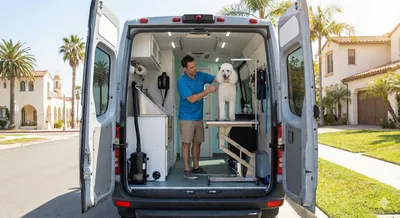
3. Mobile grooming
- Van or trailer-based grooming unit
- Travels to client locations
- Multi-city business license complexity
- Wastewater disposal critical
- May need commercial vehicle registration
Once you select a model, every subsequent step—zoning, permits, taxes, and insurance—follows from it.
Part 3: Texas Business Structure and Registration
Texas has no state income tax, making it one of the most business-friendly states for entity formation. However, you still need to register your business properly.
Sole Proprietorship
A sole proprietorship requires no filing with the Texas Secretary of State. You can start operating immediately. However:
- If you use a business name other than your legal name, you must file an Assumed Name Certificate (DBA) with the county clerk
- You must register for a sales tax permit with the Texas Comptroller
- You are personally liable for all business debts and obligations
Limited Liability Company (LLC)
An LLC provides liability protection and is relatively inexpensive to form in Texas.
Official resource: Texas Secretary of State - Business Filings
- Formation: File Certificate of Formation (Form 205) with the Texas Secretary of State
- Filing fee: $300 (one-time)
- No annual report required: Unlike many states, Texas LLCs do not file annual reports
- Franchise tax: Annual filing required (see Part 5)
- Processing time: 3-5 business days for online filings
Note: Filing fees are non-refundable. If your filing is rejected, you must correct the mistake and pay again.
Corporation
Corporations also file with the Secretary of State:
- C-Corporation: $300 filing fee
- S-Corporation: Same formation fee; requires IRS election
- Subject to franchise tax like LLCs
Part 4: Assumed Name Certificate (DBA) Filing
If you operate under any name other than your legal name (for sole proprietors) or your exact registered entity name (for LLCs/corporations), you must file an Assumed Name Certificate.
Official resource: Texas Secretary of State - Name Filings FAQs
Where to file
For sole proprietors and general partnerships:
- File with the County Clerk in the county where your principal place of business is located
- Fees vary by county (typically $18-$25 for the first owner, plus $0.50 per additional owner)
For LLCs and corporations:
- File with the Texas Secretary of State (Form 503)
- Filing fee: $25
- No county filing required
County filing fee examples
| County | Filing Fee |
|---|---|
| Dallas County | $23.00 + $0.50/additional owner |
| Travis County (Austin) | $23.00 + $0.50/additional owner |
| Harris County (Houston) | Varies |
| Bexar County (San Antonio) | Varies |
| Nueces County | $18.00 + $0.50/additional owner |
Duration and renewal
- Assumed Name Certificates are valid for 10 years in Texas
- Must be renewed before expiration to maintain the name registration
- Changes in ownership require a new filing
Part 5: Texas Taxes for Pet Groomers
This is where Texas differs significantly from other states—and where groomers often make costly mistakes.
1. Texas Has No State Income Tax
Texas is one of five states with no personal state income tax.
This means:
- you do not file a state income tax return for personal income
- business profits passed through to you personally are not taxed at the state level
- this is a significant competitive advantage
However, Texas makes up for this through sales tax and franchise tax.
2. Sales Tax — Grooming Services ARE Taxable in Texas
This is critical: Pet grooming services are subject to Texas sales tax.
Official resource: Texas Comptroller - Taxable Services
Unlike California and some other states, Texas taxes services including pet grooming. This falls under the category of services involving tangible personal property (the pet).
What this means:
- You must collect sales tax on all grooming services
- Base rate: 6.25% state sales tax
- Local jurisdictions can add up to 2% additional tax
- Maximum combined rate: 8.25%
- Rates vary by location—verify your local rate
How to register
You must obtain a sales tax permit before collecting sales tax.
Official resource: Texas Comptroller - Sales Tax Permit Application
- Apply online or by mail (Form AP-201)
- No fee for the permit
- Processing time: 2-4 weeks
- Security bond may be required in some cases
Filing requirements
- Filing frequency (monthly or quarterly) is assigned based on your estimated tax liability
- You must file returns even if you have no taxable sales in a period
- Late filing results in penalties and interest
3. Texas Franchise Tax
Official resource: Texas Comptroller - Franchise Tax
Despite the name, the franchise tax applies to most business entities, not just franchises.
Who must file:
- LLCs
- Corporations
- Partnerships
- Professional associations
- Business trusts
NOT required to file:
- Sole proprietorships (unless structured as single-member LLCs)
- General partnerships owned entirely by natural persons
The No Tax Due Threshold
For report years 2024 and later, businesses with annualized total revenue at or below $2,470,000 owe no franchise tax.
Important changes for 2024-2025:
- If your revenue is at or below the no tax due threshold, you are not required to file a No Tax Due Report
- However, you must still file a Public Information Report (PIR) annually (Form 05-102)
- Due date: May 15 each year
Official resource: Texas Comptroller - No Tax Due Reporting Updates
Franchise tax rates (if above threshold)
If your revenue exceeds $2.47 million:
- Retail and wholesale: 0.375%
- Other businesses: 0.75%
- Calculated on margin (revenue minus cost of goods sold or compensation, whichever is greater)
Most small grooming businesses will never hit this threshold, but you must still file the PIR.
4. Federal Taxes
Don’t forget federal obligations:
- Federal income tax: Report business income on personal return (sole proprietorship, LLC) or business return (corporation)
- Self-employment tax: 15.3% on net earnings (Social Security and Medicare)
- Quarterly estimated taxes: Required if you expect to owe $1,000+ in federal tax
Part 6: City Business Licenses
Texas cities vary dramatically in their business license requirements.
Who needs a city business license
- Storefront salons inside city limits
- Home-based groomers inside city limits
- Mobile groomers operating within city limits
City-by-city variation
Texas has no statewide business license requirement. Each city sets its own rules.
Some cities have no general business license requirement. Others require registration and annual fees.
Houston
Houston does not require a general business license for most businesses. However, animal-related businesses face specific requirements (see Part 7).
Dallas
Dallas requires a Certificate of Occupancy for commercial locations but does not require a general business license. Contact the Dallas Business Licensing Division for specific requirements.
Austin
Austin requires business registration through the Development Services Department for commercial locations. Home-based businesses may need home occupation permits through Planning and Zoning.
San Antonio
San Antonio requires a business tax certificate for some businesses. Contact the City Clerk’s Office for requirements.
Fort Worth
Fort Worth does not require a general business license but does regulate animal establishments through Code Compliance.
Part 7: City Animal Facility Permits
This is where Texas gets complicated. Major cities require specific permits for animal-related businesses.
Houston — Commercial Pet Service Facility License
Official resource: Houston BARC - Commercial Pet Facility Permit
Houston requires a Commercial Pet Service Facility License for any lot, enclosure, structure, or building where dogs or cats over the age of four months are kept or maintained for any commercial purpose—including grooming.
Requirements:
- Annual license required by January 1 each year
- Application submitted to BARC Animal Shelter
- Copy of current ID required
- Certificate must be displayed prominently
- Subject to inspection by BARC Animal Enforcement
- Governed by Houston Municipal Code Chapter 6, Division 5, Sections 121-130
Contact:
- BARC Animal Shelter: 3200 Carr Street, Houston, TX 77026
- Phone: 832-393-8579
PDF Application: Commercial Pet Service Facility License Application
San Antonio — Grooming Shop License
Official resource: City of San Antonio - Permits & Fees
San Antonio explicitly requires a grooming shop license. No person shall operate any grooming shop without first obtaining a license from the Director.
Requirements:
- License valid for one (1) year
- Application submitted to Animal Care Services
- Investigation of applicant’s qualifications
- $25 inspection fee to initiate final inspection
- Failure to apply before opening or within 30 days of renewal date is a misdemeanor offense
Key provisions:
- Shop may require proof of vaccinations from pet owners
- Subject to inspections by Animal Care Services officers
PDF Application: San Antonio Grooming Shop License
Dallas
Dallas regulates animal-related businesses through the Dallas City Code, Chapter 7 (Animals). Grooming businesses should contact Dallas Animal Services for specific permit requirements.
Key requirements typically include:
- Kennel license may be required depending on facility classification
- Compliance with Dallas County animal control codes
- Facility inspection may be required
- Zoning verification
Contact: Dallas Animal Services
Fort Worth
Fort Worth defines “Animal Establishment” to include grooming shops and regulates them through Chapter 6 of the City Code.
Official resource: Fort Worth Animal Licensing and Fees
Requirements:
- Animal establishment registration may be required
- Licenses available at Animal Care & Control Center
- Subject to Code Compliance oversight
Austin
Austin regulates pet-related businesses through Title 3 (Animal Regulation) of the City Code. Contact Austin Animal Services for specific requirements.
Key considerations:
- Pet Trader Ordinance may apply to some businesses
- Zoning approval required
- Home-based businesses subject to home occupation rules
Official resource: City of Austin Pet Trader Ordinance
Part 8: Zoning (The Step That Can Stop Everything)
Zoning approval is mandatory before opening any grooming business in Texas.
Storefront zoning
You must confirm that:
- Pet grooming is an allowed or conditional use in your zoning district
- Parking requirements can be met
- Signage is permitted
- Noise ordinances won’t create issues
Contact your city’s Planning or Development Services department for zoning verification.
Home-based zoning — Texas varies widely
Texas cities have different approaches to home occupations:
Houston: Houston is famously known for having minimal zoning restrictions. However, deed restrictions and HOA rules still apply, and the Commercial Pet Service Facility License requirements still apply to home-based operations.
Dallas: Dallas has home occupation provisions but may restrict pet grooming based on:
- Number of client visits
- Number of animals on premises
- Noise and parking concerns
Austin: Austin home occupation rules typically restrict:
- Square footage used for business
- Number of employees
- Client visits per day
- Signage
San Antonio: San Antonio’s home occupation rules are stricter. The grooming shop license requirement may still apply to home-based operations.
What to check everywhere:
- Contact your city’s Planning Department about “pet grooming as a home occupation”
- Ask about limits on: animals on-site at once, customer visits per day, hours of operation, signage
- Check HOA rules—even if zoning allows it, HOA CC&Rs may prohibit commercial activity
Mobile grooming zoning
Mobile groomers face different issues:
- Where you park/store your mobile unit matters
- Your business registration address still needs to comply with zoning
- Some neighborhoods or HOAs prohibit commercial vehicles
- City commercial pet facility permits may still apply
Part 9: Wastewater and Environmental Compliance
Official resource: Texas Commission on Environmental Quality (TCEQ)
Texas takes environmental compliance seriously through TCEQ and local authorities.
Key rule
Grooming wastewater must go to the sanitary sewer system, never the storm drain.
Storm drains flow directly to creeks, rivers, and bays without treatment. Grooming wastewater contains hair, chemicals, and biological matter.
Storefront operations
Commercial spaces typically have proper sewer connections. Verify with your landlord and local utility authority.
Home-based operations
- Wastewater from grooming activities generally goes down indoor drains to the sanitary sewer or septic system
- Septic systems: Some jurisdictions may have concerns about commercial wastewater volume—check with your county
Mobile grooming — Critical compliance area
Mobile groomers must:
- Capture all wastewater in onboard holding tanks
- Dispose of wastewater properly—never into storm drains, streets, or yards
- Options: discharge at approved dump stations, RV dump facilities, or with permission at properties connected to sanitary sewer
Contact TCEQ’s Small Business and Local Government Assistance at 800-447-2827 for specific guidance on mobile grooming wastewater disposal requirements.
Part 10: Animal Welfare and Operating Standards
While Texas does not have statewide groomer regulations, animal cruelty laws apply to all animal businesses.
Texas animal cruelty laws
Texas Penal Code Chapter 42 covers cruelty to animals and applies to grooming operations.
Best practices:
- Humane handling of all animals
- Adequate ventilation and temperature control
- Secure containment—no unattended animals in unsafe conditions
- Immediate response to injuries or illness
- Fresh water available
- Clean, sanitary conditions
Vaccination verification
While not universally required, many cities and facilities allow or require groomers to verify vaccination status. San Antonio’s ordinance explicitly permits this.
Recordkeeping
Maintain records of:
- Animals serviced (owner contact, pet identification)
- Services provided
- Any incidents or injuries
Professional grooming salon software with digital compliance tracking and vaccination management helps ensure documentation is audit-ready and accessible during inspections.
Part 11: Insurance (Not Optional in Practice)
Insurance isn’t legally required in most Texas jurisdictions, but operating without it is reckless.
Essential coverages
- General liability: Covers injuries to clients or their property on your premises
- Care, custody, and control (CCC) / Animal bailee coverage: Covers injuries to pets in your care—standard policies often exclude this
- Professional liability: Covers claims of negligence in grooming
- Commercial auto (mobile groomers): Covers vehicle accidents during business operations
- Property/equipment coverage: Covers grooming tools, supplies, and equipment
- Workers’ compensation (if hiring employees): Required by Texas law for most employers
Home-based groomer warning
Homeowners insurance typically excludes business activities. If a dog is injured during grooming at your home, your homeowners policy almost certainly won’t cover it. You need separate business insurance.
Typical coverage amounts
- General liability: $1-2 million
- Professional liability: $500,000-$1 million
- CCC/Bailee: Up to replacement value of animals in care
Part 12: Home-Based vs Mobile vs Storefront — Key Differences
Home-based
- Lowest overhead
- Most zoning-sensitive—varies widely by Texas city
- May still require city commercial pet facility permits (Houston, San Antonio)
- Insurance more complicated
- HOA restrictions common
Mobile
- Multi-city licensing complexity—may need permits wherever you operate
- Wastewater capture and disposal is critical
- Commercial auto insurance required
- Commercial pet facility permits may still apply depending on city
- Flexible but higher operating costs
Storefront
- Highest startup cost
- Most straightforward zoning and permitting
- City animal facility permits almost always required in major cities
- Subject to facility inspections
- Clearest regulatory path
Part 13: Regional Examples — Major Texas Cities
Houston
Requirements:
- Texas sales tax permit (Comptroller)
- Commercial Pet Service Facility License (BARC)
- Zoning/deed restriction verification
- Franchise tax filing (Public Information Report)
- Business insurance
Key contacts:
- BARC Animal Shelter: 832-393-8579
- Houston Permitting Center: houstonpermittingcenter.org
San Antonio
Requirements:
- Texas sales tax permit (Comptroller)
- Grooming Shop License (Animal Care Services)
- $25 inspection fee
- Zoning verification
- Franchise tax filing
Key contacts:
- Animal Care Services: sa.gov/acs
- 311 for general city information
Dallas
Requirements:
- Texas sales tax permit (Comptroller)
- Certificate of Occupancy (if commercial location)
- Animal Services permit may be required
- Zoning verification
- Franchise tax filing
Key contacts:
- Dallas Animal Services
- Dallas Development Services
Austin
Requirements:
- Texas sales tax permit (Comptroller)
- Business registration (Development Services)
- Zoning/home occupation approval
- Pet Trader Ordinance compliance (if applicable)
- Franchise tax filing
Key contacts:
- Austin Animal Services
- Development Services Department
Fort Worth
Requirements:
- Texas sales tax permit (Comptroller)
- Animal Establishment registration (if required)
- Zoning verification
- Franchise tax filing
Key contacts:
- Fort Worth Code Compliance: fortworthtexas.gov
El Paso — Special Case: Individual Groomer Licensing Required
El Paso is unique in Texas for requiring individual groomer licenses.
Official resource: El Paso Animal Services - Permits & Licenses
Individual groomer requirements:
- Must obtain an animal groomer certificate or complete director-approved training course
- Background check required
- License must be carried at all times when grooming
- Valid state-issued photo ID required
Grooming shop requirements:
- Shop permit required and must be posted
- Must maintain list of all groomers
- Must require background checks of groomers
- Must maintain shop hygiene and conditions
- Must implement precautions to prevent animal abuse
- Must provide means for owners to observe grooming process
- Must ensure all pets are current on vaccines and microchips
- Must report all injuries or deaths
- Must maintain records for two years
Penalties:
- Licenses can be revoked or suspended
- Fines range from $4,000 to $10,000
- Potential jail time up to 22 years for serious offenses
Application:
- Apply through City of El Paso Online Licensing Portal
- Email: epasgrooming@elpasotexas.gov
Part 14: Practical Compliance Checklist
Universal (all Texas groomers)
- Decide on business structure (sole proprietorship, LLC, corporation)
- Register LLC/Corporation with Texas Secretary of State ($300) if applicable
- File Assumed Name Certificate (DBA) if using a business name
- Obtain Federal EIN from IRS
- Register for Texas sales tax permit (Comptroller)
- Set up sales tax collection and remittance system
- Register for franchise tax (even if no tax due, file PIR)
- Secure business insurance (general liability, CCC/bailee coverage)
- Open business banking account
Storefront
- Confirm zoning permits commercial pet grooming
- Obtain Certificate of Occupancy if required
- City animal facility permit (Houston, San Antonio, etc.)
- Building permits if doing construction/renovation
- Fire department clearance if required
- Facility inspection
Home-based
- Confirm pet grooming is allowed as home occupation
- Home occupation permit if required
- Check city animal facility license requirements
- Verify HOA allows commercial activity
- Update insurance (business rider or separate policy)
Mobile
- Commercial vehicle registration
- Commercial auto insurance
- Wastewater capture system
- Disposal plan (identify RV dump stations or approved facilities)
- Business licenses/permits for each city where you operate
- City animal facility permits if required
Part 15: Key Texas Taxes Summary
| Tax | Who Pays | Amount | When |
|---|---|---|---|
| State Sales Tax | All groomers | 6.25% (+ up to 2% local) | When service occurs; remit monthly or quarterly |
| Franchise Tax | LLCs, Corporations | $0 if revenue under $2.47M | File PIR by May 15 annually |
| Franchise Tax | LLCs, Corps over threshold | 0.375% - 0.75% of margin | May 15 annually |
| Federal Income Tax | All | Varies by income | Quarterly estimates + annual |
| Self-Employment Tax | Sole props, LLC members | 15.3% | With federal income tax |
Part 16: Common Mistakes and How to Avoid Them
Mistake 1: Not collecting sales tax
Unlike California, grooming services are taxable in Texas. Failing to collect and remit sales tax is a serious compliance violation.
Solution: Register for a sales tax permit before opening. Set up your point-of-sale system to automatically calculate and collect the correct local rate.
Mistake 2: Ignoring city-level requirements
Major Texas cities have animal facility permit requirements that groomers often miss.
Solution: Contact your city’s animal services department before opening to confirm all local requirements.
Mistake 3: Not filing franchise tax reports
Even if you owe no franchise tax, LLCs and corporations must file a Public Information Report by May 15 each year.
Solution: Set a calendar reminder for April to file your PIR.
Mistake 4: Operating in El Paso without individual licenses
El Paso is the only Texas city requiring individual groomer licensing. Groomers who move to El Paso or work there temporarily must comply.
Solution: If operating in El Paso, complete the required training and obtain your groomer license before working.
Mistake 5: Assuming Houston has no regulations
Houston’s lack of traditional zoning leads groomers to think there are no regulations. The Commercial Pet Service Facility License requirement still applies.
Solution: Apply for your BARC Commercial Pet Service Facility License before operating.
Part 17: Resources and Contacts
State-level
Texas Secretary of State – Business Filings
- Website: sos.state.tx.us/corp
- Phone: 512-463-5555
- Services: LLC/Corporation formation, assumed names
Texas Comptroller of Public Accounts
- Website: comptroller.texas.gov
- Sales Tax Permit: comptroller.texas.gov/taxes/permit
- Franchise Tax: comptroller.texas.gov/taxes/franchise
- Phone: 800-252-5555
Texas Department of Licensing and Regulation (TDLR)
- Website: tdlr.texas.gov
- Note: TDLR does NOT regulate pet groomers
Texas Commission on Environmental Quality (TCEQ)
- Website: tceq.texas.gov
- Small Business Assistance: 800-447-2827
- Wastewater permits: tceq.texas.gov/permitting/wastewater
City contacts
Houston
- BARC Animal Shelter: 832-393-8579
- Website: houstontx.gov/barc
- Houston Permitting Center: houstonpermittingcenter.org
San Antonio
- Animal Care Services: sa.gov/acs
- Permits & Fees: sa.gov/Directory/Departments/ACS/Laws-Fees/Permits
- 311 for general information
Dallas
- Dallas Animal Services
- City Code Chapter 7: animallaw.info/local/tx-dallas
Austin
- Austin Animal Services
- Development Services: austintexas.gov
- Pet Trader Ordinance: austintexas.gov/animal-services/responsible-pet-acquisition
Fort Worth
- Code Compliance - Animals: fortworthtexas.gov/code-compliance/animals
- Animal Licensing: fortworthtexas.gov/code-compliance/animals/service/fees
El Paso
- Animal Services: elpasoanimalservices.org
- Permits & Licenses: elpasoanimalservices.org/services/permits-and-licenses
- Email: epasgrooming@elpasotexas.gov
County Clerk contacts (for DBA filings)
Harris County (Houston)
- Website: cclerk.hctx.net
Dallas County
- Website: dallascounty.org/county-clerk
- Assumed Names: dallascounty.org/county-clerk/recording/assumed-names
Travis County (Austin)
- Website: countyclerk.traviscountytx.gov
- DBAs: countyclerk.traviscountytx.gov/departments/recording/dbas
Bexar County (San Antonio)
- Website: bexar.org
- Assumed Names: bexar.org/2958/Assumed-Business-NamesDBAs
Tarrant County (Fort Worth)
- Contact county clerk for assumed name filings
Final Reality Check
Texas makes it easy to start grooming—there’s no professional license barrier and business formation is straightforward.
But Texas also has real compliance requirements that many groomers miss:
There is no groomer license—but there are:
- mandatory sales tax collection on grooming services
- franchise tax filing requirements (even if no tax due)
- city animal facility permits in major cities (Houston, San Antonio, etc.)
- individual groomer licensing in El Paso
- zoning approval requirements that vary by city
- wastewater regulations (especially for mobile groomers)
If you approach setup in order—business structure → tax registration → city permits → zoning → insurance—you avoid expensive corrections later.
Compliance protects:
- your business from fines and closure
- your clients from liability issues
- the animals in your care
And it keeps you operating legally in the Lone Star State.
Take the Next Step
Once you’ve navigated Texas’s licensing requirements and are ready to operate, professional grooming salon software built for Texas groomers helps you manage the operational side—scheduling, client records, digital agreements, and compliance tracking—so you can focus on grooming instead of paperwork.
Start your free trial today and see how Packyard handles vaccination tracking, digital waivers, appointment management, and client communication in one platform.
Critical Reminder: Verify Everything Locally
This guide provides a general framework only. Requirements, fees, rates, and procedures change frequently and vary significantly by jurisdiction.
Before making any business decisions:
- Contact the Texas Comptroller for current sales tax rates and permit requirements
- Contact your specific city’s animal services department for facility permit requirements
- Contact your city’s planning/zoning department for zoning verification
- Verify all franchise tax thresholds and requirements with the Comptroller
- Contact your county clerk for current DBA filing fees
- Verify all information at the official sources linked in Part 17
Do not rely solely on this guide. Use it as a starting point for your research, then verify every detail with the relevant authorities before proceeding.
This article is informational and not legal advice. Always confirm requirements with your city, county, the Texas Secretary of State, and the Texas Comptroller before opening. Regulations, fees, and requirements change frequently—verify current information with official sources.