· Packyard Team · Pet Grooming License & Business Requirements · 12 min read
California Pet Grooming License Requirements (2025)
Step-by-step guide to starting a pet grooming business in California. Covers permits, licensing, taxes, zoning, and compliance.
Pet Grooming License & Business Requirements in California (2025): The Complete Guide
Starting a pet grooming business in California sounds simple. It isn’t.
You’ll often hear:
“California doesn’t require a pet groomer license.”
That statement is true, but it obscures the real compliance burden. California regulates pet grooming as a business, as a taxable activity, and through county animal services departments—not as a licensed profession.
This guide covers storefront salons, home-based groomers, and mobile grooming businesses, with special attention to California’s $800 LLC franchise tax, county animal facility licenses, and the zoning rules that catch many groomers off guard.
Part 1: Do You Need a Pet Groomer License in California?
The short answer
No. California does not issue a professional license for pet groomers. Grooming is not regulated by the California Department of Consumer Affairs or any state cosmetology board.
There is:
- no state grooming board
- no state exam
- no mandatory certification
- no continuing education requirement
You can legally groom pets without a professional grooming license.
The important clarification
“No license required” does not mean “unregulated.”
California regulates grooming businesses through:
- state business registration and taxation
- city and county business licenses
- county animal services and animal facility licensing
- zoning and land-use controls
- wastewater and environmental compliance
The complexity comes from California’s layered regulatory structure: state, county, and city governments each have their own requirements, and they don’t always align.
Part 2: Choose Your Business Model First (Everything Depends on This)
Before registering anything, decide how you will operate, because the rules vary significantly by model.
Common grooming business models
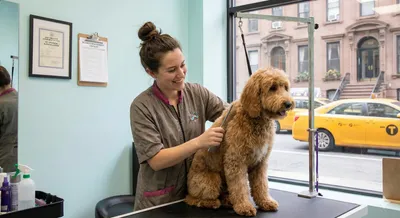
1. Storefront grooming salon
- Commercial lease or owned retail space
- Clients drop off and pick up pets
- Highest startup cost, clearest regulatory structure
- Most likely to require county animal facility license
2. Home-based grooming
- Operates from a residence (garage, converted room, outbuilding)
- Lower overhead
- Most zoning-sensitive—some California cities prohibit pet grooming as a home occupation entirely
- May still require animal facility licensing depending on county
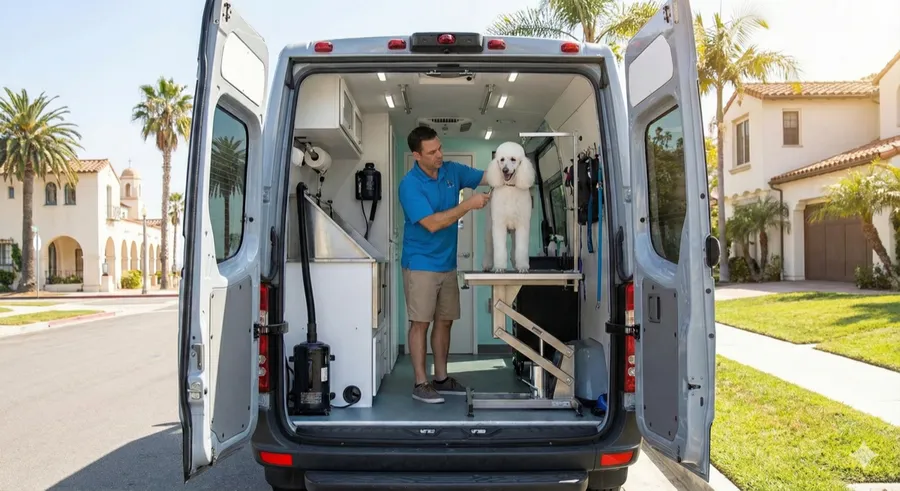
3. Mobile grooming
- Van or trailer-based grooming unit
- Travels to client locations
- Multi-city business license complexity
- Wastewater disposal is critical—California has strict environmental rules
- May need commercial vehicle registration
Once you pick a model, every later step—zoning, permits, inspections, taxes, and insurance—follows from it.
Part 3: California Business Structure and Registration
California does not have a single “state business license.” Instead, you register your business entity and tax accounts separately.
Sole Proprietorship
A sole proprietorship requires no filing with the California Secretary of State. You can start operating immediately. However:
- If you use a business name other than your legal name, you must file a Fictitious Business Name Statement (DBA) with the county clerk
- You must register for applicable taxes with the Franchise Tax Board and CDTFA
- You are personally liable for all business debts and obligations
Limited Liability Company (LLC)
An LLC provides liability protection but comes with California’s steep franchise tax.
- Formation: File Articles of Organization with the California Secretary of State ($70 filing fee)
- Annual Franchise Tax: $800 per year, regardless of revenue or profit
- Due date: 15th day of the 4th month after LLC formation, then annually by April 15
- No first-year exemption: The AB 85 waiver expired December 31, 2023—all LLCs formed after January 1, 2024 must pay the $800 in their first year
LLC Fee for Higher Revenue
If your LLC earns more than $250,000 in California source income, you owe an additional fee:
- $250,000–$499,999: $900 fee
- $500,000–$999,999: $2,500 fee
- $1,000,000–$4,999,999: $6,000 fee
- $5,000,000+: $11,790 fee
This is in addition to the $800 franchise tax.
Corporation
Corporations (C-Corp or S-Corp) also pay the $800 minimum franchise tax. Corporations pay franchise tax based on a percentage of net income: 8.84% for C corporations, 1.5% for S corporations, with an $800 minimum.
Part 4: Fictitious Business Name (DBA) Filing
If you operate under any name other than your legal name (for sole proprietors) or your exact registered entity name (for LLCs/corporations), you must file a Fictitious Business Name Statement.
Requirements
- Filing location: County Clerk in the county where your principal place of business is located
- Filing fee: Typically $40–$90 depending on the county
- Filing deadline: Within 40 days of first transacting business under the fictitious name
- Publication requirement: Must publish the statement in a newspaper of general circulation once per week for four consecutive weeks
- Publication deadline: Must begin within 45 days of filing
- Duration: Valid for 5 years from filing date
- Changes: Any change to ownership, business name, or address requires a new filing within 40 days
County-specific examples
- Los Angeles County: File at LA County Registrar-Recorder/County Clerk
- San Diego County: File at San Diego County Clerk
- Orange County: File at Orange County Clerk-Recorder
- San Francisco: File at SF Office of the County Clerk
Part 5: Taxes for Pet Groomers in California
California has no personal income tax exemption for small businesses. All income is taxable.
1. State Income Tax
- Sole proprietors: Report business income on personal California income tax return (Form 540)
- LLCs/Corporations: File separate business tax returns with the Franchise Tax Board
- Tax rates: Progressive rates from 1% to 12.3% for personal income
2. Franchise Tax (LLCs and Corporations)
As noted above:
- $800 minimum annually for LLCs and corporations
- Due regardless of income or business activity
- Only ends when you properly dissolve the entity with both the Secretary of State and Franchise Tax Board
3. Sales Tax — Grooming Services Are Generally NOT Taxable
This is the key difference from some other states.
Pet grooming services in California are generally not subject to sales tax. California taxes the sale of tangible personal property, not services.
However, if you sell retail products—shampoos, conditioners, brushes, treats, accessories—those sales are taxable.
What this means
- Grooming fees: NOT taxable
- Retail product sales: TAXABLE at your local rate (ranging from 7.25% to 10.75% depending on location)
If you sell any retail products, you must:
- Register for a Seller’s Permit with the California Department of Tax and Fee Administration (CDTFA)
- Collect sales tax at the point of sale
- File regular returns and remit collected tax
Part 6: City Business Licenses
Most California cities require a city business license (sometimes called a business tax certificate) to operate any business.
Who needs a city business license
- Storefront salons inside city limits
- Home-based groomers inside city limits
- Mobile groomers operating within city limits
Key points
- Location-based: You need a license from the city where your business is physically located
- Fee structure: Varies widely—some cities charge flat fees ($50–$300), others base fees on gross receipts
- Renewal: Typically annual
- Mobile groomers: May need licenses from multiple cities if you earn revenue in different jurisdictions
City examples
- Los Angeles: Business Tax Registration Certificate from the Office of Finance
- San Diego: Business Tax Certificate from the City Treasurer
- San Francisco: Business Registration Certificate from the Treasurer & Tax Collector
- San Jose: Business Tax from the Finance Department
If your business is in an unincorporated area, you typically need a county business license instead.
Part 7: County Animal Facility Licenses
This is where California regulation becomes more intensive than many groomers expect.
Many California counties require an Animal Facility License for grooming businesses. This is separate from your business license and specifically regulates animal care facilities.
Los Angeles County
Los Angeles County Department of Animal Care and Control (DACC) regulates grooming businesses as “animal facilities.”
Requirements include:
- Animal Facility License application and fee
- Facility inspection
- Letter grade system based on inspection findings (similar to restaurant grades)
- Compliance with sanitation and animal welfare standards
- Animals may not be kept overnight at grooming parlors
Who needs to license:
- Grooming shops (storefront)
- Mobile groomers
- Any facility where animals are kept, groomed, or cared for commercially
Orange County
Orange County Animal Care explicitly requires Animal Facility Business Licenses for:
- Grooming parlors
- Mobile groomers
- Pet shops
- Boarding facilities
Routine inspections verify animal welfare and recordkeeping.
San Diego County
San Diego County Department of Animal Services handles animal business licensing for unincorporated areas. Cities within San Diego County may have their own requirements through San Diego Humane Society or city animal services.
Other Counties
Requirements vary significantly. Always check with:
- County Department of Animal Services/Animal Care and Control
- County Health Department
- County Planning Department
Part 8: Zoning (The Step That Can Stop Everything)
Zoning can prohibit a grooming business even if all other licenses are in place.
Storefront zoning
Commercial retail space is generally the simplest path. Verify that:
- Pet grooming is a permitted use in the zoning district
- Plumbing and waste disposal meet commercial standards
- Parking requirements can be satisfied
- Noise ordinances won’t create issues
Home-based zoning — California is especially restrictive
California cities vary dramatically in their treatment of home-based pet grooming:
Cities that prohibit pet grooming as a home occupation:
- Sacramento: Home occupation rules explicitly state that pet services, including grooming, are NOT permitted at the residence
- Hanford: Lists pet grooming among prohibited home occupations
Cities that may allow with restrictions:
- Some cities allow home grooming with strict conditions: limits on customers per day, no exterior signage, no employees, specific parking requirements, no animal noise
What to check:
- Contact your city’s Planning Department specifically about “pet grooming as a home occupation”
- Ask about limits on: animals on-site at once, customer visits per day, hours of operation, signage, noise
- Check HOA rules if applicable—even if zoning allows it, HOA CC&Rs may prohibit commercial activity
Mobile grooming zoning
Mobile groomers face different issues:
- Where you park/store the vehicle matters—residential zoning may prohibit commercial vehicle storage
- Your business registration address still needs to comply with zoning
- Some neighborhoods or HOAs prohibit commercial vehicles
Part 9: Wastewater and Environmental Compliance
California takes environmental compliance seriously. Improper wastewater disposal can result in significant fines.
Key rule
Grooming wastewater must go to the sanitary sewer system, never the storm drain.
Storm drains flow directly to creeks, rivers, and the ocean without treatment. Grooming wastewater contains hair, chemicals, and biological matter.
Storefront operations
Commercial spaces typically have proper sewer connections. Verify with your landlord and local wastewater authority.
Home-based operations
- Wastewater from grooming activities generally goes down indoor drains to the sanitary sewer
- Septic systems: Some jurisdictions restrict or prohibit commercial wastewater discharge to residential septic—check with your county
Mobile grooming — Critical compliance area
Mobile groomers must:
- Capture all wastewater in holding tanks
- Dispose of wastewater properly—never into storm drains, gutters, or yards
- Options: discharge to sanitary sewer cleanout (may require permit), take to approved disposal facility
Contact your local wastewater authority or sanitation district for specific requirements. Some jurisdictions require a one-time discharge permit.
Part 10: Animal Welfare and Operating Standards
Counties with animal facility licensing typically require compliance with animal care standards:
Common requirements
- Humane handling of all animals
- Adequate ventilation and lighting
- Cleanable, sanitized surfaces
- Secure containment—no unattended animals
- Temperature control—protection from heat stress
- Fresh water available
- Incident response procedures
Vaccination verification
While not universally required, many facilities verify rabies vaccination. It’s standard practice and reduces liability.
Recordkeeping
Maintain records of:
- Animals serviced (owner contact, pet identification)
- Services provided
- Any incidents or injuries
Part 11: Insurance (Not Optional in Practice)
Insurance isn’t legally required in most cases, but operating without it is reckless.
Essential coverages
- General liability: Covers injuries to clients or their property on your premises
- Care, custody, and control (CCC) / Animal bailee coverage: Covers injuries to pets in your care—standard homeowners policies exclude this
- Professional liability: Covers claims of negligence in grooming
- Commercial auto (mobile groomers): Covers vehicle accidents during business operations
- Property/equipment coverage: Covers grooming tools, supplies, and equipment
- Workers’ compensation (if hiring employees): Required by California law
Home-based groomer warning
Homeowners insurance typically excludes business activities. If a dog is injured during grooming at your home, your homeowners policy almost certainly won’t cover it. You need separate business insurance.
Part 12: Home-Based vs Mobile vs Storefront — Key Differences
Home-based
- Lowest overhead
- Highest zoning risk—many California cities prohibit entirely
- May still require county animal facility license
- Insurance more complicated
- Wastewater: indoor drains to sanitary sewer
Mobile
- Multi-city licensing complexity—need business license wherever you operate
- Wastewater capture and disposal is critical
- Commercial auto insurance required
- Commercial vehicle registration may be required depending on vehicle size
- Some county animal facility license requirements apply
Storefront
- Highest startup cost
- Most straightforward zoning
- County animal facility license almost always required
- Subject to facility inspections and grading
Part 13: County Examples — Why Local Research Matters
Los Angeles County (Unincorporated)
- California business structure (LLC or sole proprietorship with DBA)
- LA County business license
- DACC Animal Facility License
- Zoning confirmation from LA County Planning
- Facility inspection and letter grade
City of Los Angeles
- California business structure
- City of Los Angeles Business Tax Registration Certificate (Office of Finance)
- LA Animal Services permit (for animal-related businesses)
- Zoning compliance
Orange County (Unincorporated)
- California business structure
- County business license
- OC Animal Care Animal Facility License
- Inspections
San Diego Area
- California business structure
- City business license (varies by city) OR county license (unincorporated)
- Animal services licensing requirements vary by jurisdiction—San Diego Humane Society handles many cities; County Animal Services handles unincorporated areas
Part 14: Practical Compliance Checklist
Universal (All Groomers)
- Choose business structure (sole proprietorship, LLC, corporation)
- File DBA if using a fictitious business name
- Register with Franchise Tax Board (LLC/Corp: pay $800 franchise tax)
- Obtain Seller’s Permit from CDTFA if selling retail products
- Obtain city or county business license
- Check county animal facility license requirements
- Secure insurance (general liability, CCC/bailee coverage)
- Set up business banking
Storefront
- Confirm zoning permits commercial pet grooming
- Building permits if doing construction/renovation
- County animal facility license and inspection
- Fire department clearance if required
- Health department clearance if required
Home-based
- Confirm pet grooming is allowed as home occupation (call Planning Department)
- Home occupation permit if required
- Check county animal facility license requirements
- Verify wastewater disposal (septic vs sewer)
- Check HOA rules
- Update insurance (business rider or separate policy)
Mobile
- Commercial auto insurance
- Commercial vehicle registration if required
- Wastewater capture system
- Disposal plan (sewer cleanout permit or disposal facility)
- Business licenses for each city where you operate
- County animal facility license if required
Part 15: Key California Taxes Summary
| Tax | Who Pays | Amount | When |
|---|---|---|---|
| LLC Franchise Tax | All LLCs | $800/year minimum | 15th day of 4th month, then April 15 |
| LLC Fee | LLCs earning >$250K | $900–$11,790 | With annual return |
| Corporation Franchise Tax | All corporations | $800 minimum or 1.5%/8.84% of income | Varies |
| Sales Tax | Groomers selling products | 7.25%–10.75% | When retail sale occurs |
| State Income Tax | All | 1%–12.3% | Annual filing |
Final Reality Check
California makes it easy to start grooming but creates significant compliance burdens that accumulate fast.
There is no groomer license—but there are:
- $800 annual franchise taxes for LLCs
- City business licenses
- County animal facility licenses with inspections
- Strict zoning that varies city to city
- Wastewater rules that especially impact mobile groomers
The regulatory landscape varies dramatically by location. A groomer in Sacramento faces different rules than one in Los Angeles County, which faces different rules than one in San Diego.
If you approach setup in order—business structure → taxes → zoning → permits → inspections—you avoid expensive corrections later.
Compliance protects:
- your business
- your clients
- the animals in your care
And it keeps you operating legally.
This article is informational and not legal advice. Always confirm requirements with your city, county, California Secretary of State, Franchise Tax Board, and local animal services before opening.