· Packyard Team · Pet Grooming License & Business Requirements · 15 min read
Pet Grooming License & Business Requirements in New York (2025)
Step-by-step guide to starting a pet grooming business in New York. Covers permits, licensing, taxes, and compliance.
Pet Grooming License & Business Requirements in New York (2025): The Complete Guide
Starting a pet grooming business in New York is more complicated than most states. Here is why.
New York does not have a statewide professional license for pet groomers. But New York City requires a permit from the Department of Health and Mental Hygiene. Suffolk County requires registration with the Department of Consumer Affairs. And every LLC formed in New York must complete the infamous publication requirement that can cost $1,500+ in New York City.
This guide covers storefront salons, home-based groomers, and mobile grooming businesses across New York State, with specific attention to NYC regulations, Long Island requirements, and upstate considerations.
Part 1: Do You Need a Pet Groomer License in New York?
At the state level
No. New York State does not currently require a professional license to work as a pet groomer. There is:
- no state grooming board
- no state exam
- no mandatory certification
- no continuing education requirement
You can legally groom pets in New York without a professional license.
Pending legislation
The New York State Legislature has repeatedly considered bills to change this. In 2025, two active bills are being considered:
Assembly Bill A1108 (2025): Introduced January 9, 2025, this bill would require licensing of pet grooming facilities and establish standards of care and record keeping requirements.
Senate Bill S6963 (2025): Introduced March 27, 2025, this bill would require registration and regulation of pet groomers, establish training and testing standards, and require applicants to be at least 18 years old. Violations would carry penalties of $100 to $500 per offense.
The justification for these bills cites several cases of healthy dogs dying while in the care of grooming facilities, particularly mobile operations.
As of this writing, neither bill has passed. But the regulatory landscape could change. Monitor the New York State Senate website for updates.
At the local level
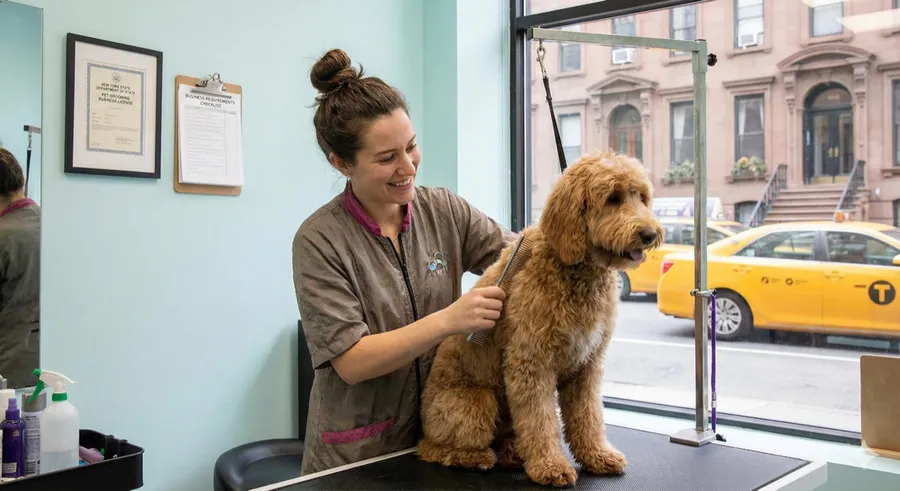
New York City requires a Small Animal Grooming Establishment Permit from the NYC Department of Health and Mental Hygiene (DOHMH). This is not optional.
Suffolk County requires pet grooming businesses to register with the Suffolk County Department of Labor, Licensing and Consumer Affairs.
Other counties and municipalities may have their own requirements. The absence of a state license does not mean unregulated.
Part 2: Choose Your Business Model First
The rules vary significantly based on how you operate.
1. Storefront grooming salon
- Commercial lease or owned retail space
- Clearest regulatory path
- In NYC: requires DOHMH permit, inspection, and Animal Care and Handling Certificate
- Sales tax registration required statewide
2. Home-based grooming
- Operates from a residence
- Prohibited in New York City under Health Code Section 161.15
- May be possible in other parts of New York State depending on local zoning
- Subject to municipal home occupation rules
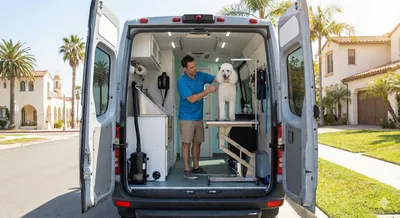
3. Mobile grooming
- Van or trailer-based grooming unit
- Subject to the same permit requirements as storefronts in NYC
- Must comply with wastewater disposal requirements
- Suffolk County registration applies to mobile groomers
- Commercial vehicle considerations apply
Part 3: New York Business Structure and Registration
Sole Proprietorship
A sole proprietorship requires no filing with the New York Department of State. However:
- If you operate under any name other than your legal name, you must file a Business Certificate (DBA) with the county clerk
- You must register for sales tax with the New York Department of Taxation and Finance
- You are personally liable for all business debts
Limited Liability Company (LLC)
An LLC provides liability protection but comes with New York’s unique publication requirement.
Formation costs:
- Articles of Organization: $200 filing fee with NY Department of State
- Publication Requirement: $50-$2,000+ (see below)
- Certificate of Publication: $50 filing fee
- Biennial Statement: $9 every two years
The Publication Requirement
This is New York’s most distinctive (and expensive) LLC requirement.
Under New York LLC Law Section 206, every LLC must publish a notice of formation in two county-designated newspapers (one daily, one weekly) for six consecutive weeks, then file a Certificate of Publication with the Department of State.
Timeline: Must be completed within 120 days of formation.
Consequences of non-compliance: Your LLC cannot sue in New York courts and loses legal leverage until you comply.
Costs by location:
| Location | Estimated Publication Cost |
|---|---|
| Manhattan | $1,200-$1,600 |
| Brooklyn | $1,000-$1,500 |
| Queens | $1,000-$1,500 |
| Nassau County | $800-$1,200 |
| Suffolk County | $600-$1,000 |
| Westchester | $500-$900 |
| Albany County | $150-$400 |
| Other upstate counties | $150-$500 |
Cost-saving strategy: The publication must occur in the county where your LLC’s registered office is located. Some business owners establish their registered office in a lower-cost county like Albany. This is legal, but your registered agent must actually be located there.
Corporation
Corporations (C-Corp or S-Corp) file Articles of Incorporation with the NY Department of State for $125. Corporations do not have the publication requirement.
Part 4: Business Certificate (DBA) Filing
If you operate under any name other than your exact legal name (sole proprietors) or registered entity name (LLCs/corporations), you must file a Business Certificate.
Requirements
- Filing location: County Clerk in the county where your principal place of business is located
- Filing fee: Varies by county, typically $25-$50
- Duration: Remains valid unless business name, ownership, or address changes
County examples
- New York County (Manhattan): File at Manhattan County Clerk
- Kings County (Brooklyn): File at Kings County Clerk
- Westchester County: $35 filing fee ($25 + $10 for certified copies)
- Suffolk County: File at Suffolk County Clerk
Part 5: Taxes for Pet Groomers in New York
New York has a complex tax structure with state, city, and in some cases metropolitan taxes.
1. State Income Tax
New York has nine income tax brackets ranging from 4% to 10.9%.
- Sole proprietors: Report business income on personal New York State income tax return (Form IT-201)
- LLCs: Generally pass-through taxation; income reported on members’ personal returns
- Corporations: File corporate tax returns
2. Sales Tax: Grooming Services ARE Taxable
This is critical: Unlike California, pet grooming services are taxable in New York.
The New York Department of Taxation and Finance explicitly states that grooming and clipping services are subject to sales tax when not provided as part of veterinary medical treatment.
Sales tax rates:
- New York State base rate: 4%
- Local rates: Additional 3%-4.875% depending on location
- Combined rates: Range from approximately 7% to 8.875%
NYC sales tax: 8.875% combined rate (4% state + 4.5% city + 0.375% Metropolitan Commuter Transportation District)
What this means for groomers:
- You must register for a Certificate of Authority to Collect Sales Tax from the NY Department of Taxation and Finance
- You must charge sales tax on all grooming services
- You must file regular sales tax returns and remit collected tax
- Retail product sales (shampoos, brushes, accessories) are also taxable
Exceptions:
- Grooming provided as part of veterinary medical treatment (e.g., clipping before surgery)
- Services provided to guide dogs, hearing dogs, or service dogs
3. NYC Unincorporated Business Tax (UBT)
If you operate an unincorporated business (sole proprietorship, partnership, or LLC taxed as a partnership) in New York City, you may owe the Unincorporated Business Tax.
- Tax rate: 4% on taxable income allocated to NYC
- Filing threshold: Required if gross receipts exceed $95,000
- Credit offset: If net self-employment earnings are $100,000 or less, a credit offsets the full UBT amount
- Partial credit: For earnings between $100,000 and $150,000, a partial credit applies
Most small grooming businesses will qualify for the credit that eliminates UBT liability.
4. Metropolitan Commuter Transportation Mobility Tax (MCTMT)
Self-employed individuals with net earnings from self-employment allocated to the Metropolitan Commuter Transportation District (MCTD) may owe this tax.
The MCTD includes: Bronx, Brooklyn, Manhattan, Queens, Staten Island, Nassau, Suffolk, Westchester, Rockland, Orange, Putnam, and Dutchess counties.
Rates vary based on income level and zone.
Part 6: New York City Requirements
NYC has the most detailed pet grooming regulations in New York State.
Small Animal Grooming Establishment Permit
If you operate a grooming business in NYC, you must obtain a permit from the Department of Health and Mental Hygiene (DOHMH).
Who needs this permit: Any establishment where pets are bathed, dipped, clipped, combed, or cleaned for a fee.
Requirements
Animal Care and Handling Certificate: Your business must have a supervising manager who has completed an approved Animal Care and Handling Course. This certification is required before opening.
Workers’ Compensation and Disability Insurance: Required for all permit applicants. If exempt, provide Form CE-200 stamped by the Workers’ Compensation Board.
Certificate of Authority to Collect Sales Tax: Must show proof of registration with address matching application.
Vaccination Records: You must obtain from each dog owner:
- Proof of current rabies vaccination, AND
- Either a sworn statement or veterinary documentation that the dog is vaccinated against distemper, adenovirus, parainfluenza, parvovirus, and Bordetella
Inspection: Your business must pass a DOHMH inspection before receiving a permit.
Record Keeping: Maintain records of all grooming services for at least one year.
Dog License Distribution: You must provide dog owners with a NYC dog license application unless they show proof of current licensing.
Permit Process
- Create an account with the NYC Business Portal
- Complete application and pay fee
- Schedule inspection with DOHMH Bureau of Veterinary Public Health Services
- Pass inspection
- Ensure supervising manager has Animal Care and Handling Certificate
- Receive permit
Renewal: Permits expire December 31 each year and must be renewed.
Display requirements: Post the permit and supervising manager’s certificate where customers can see them.
Home-Based Grooming in NYC: Prohibited
NYC Health Code Section 161.15 states:
“Animals shall not be sold, held for sale, or boarded, groomed or trained in exchange for a fee in a dwelling in which a person lives.”
This means: You cannot legally operate a home-based pet grooming business in New York City, regardless of zoning.
Part 7: Suffolk County Requirements
Suffolk County has specific registration requirements for pet groomers.
Registration Requirement
No pet grooming business may operate in Suffolk County without registering with the Department of Labor, Licensing and Consumer Affairs.
Who must register: All pet grooming businesses including:
- Fixed storefronts
- Mobile grooming vans
- In-home service providers
Registration Fees
- Initial application fee: $50
- Biennial renewal fee: $100
Required Documentation
- Business name and principal address
- Names of all business owners
- Proof of professional and general liability insurance
- Proof of property damage insurance
- Proof of workers’ compensation (if applicable)
Safety Requirements
Suffolk County regulations require:
- All equipment must be in good working condition
- Pet restraints must be secure and pet-friendly
- Only pet-friendly products may be used
- Any topical pesticides must be approved by the NYS Department of Environmental Conservation
Penalties
Operating without registration or after registration revocation is a misdemeanor punishable by:
- Fine up to $5,000
- Imprisonment up to one year
- Or both
Part 8: Nassau County and Westchester County
Nassau County
Nassau County does not appear to have a specific pet groomer registration requirement comparable to Suffolk County. However, you still need:
- General business registration/DBA if applicable
- Sales tax registration
- Compliance with local municipal zoning
- Any applicable village or town business permits
Contact the Nassau County Office of Consumer Affairs to confirm current requirements.
Westchester County
Westchester County does not have a county-level pet grooming license. Requirements are handled at the municipal (city/town/village) level.
Business Certificate: If operating as a sole proprietor under a business name, file with the Westchester County Clerk for $35.
Zoning: Contact your specific municipality’s planning or zoning department for pet services zoning requirements.
Part 9: Upstate New York (Albany, Buffalo, and Beyond)
General Landscape
Upstate New York cities and towns generally do not have the intensive pet grooming regulations found in NYC or Suffolk County. However, you still need:
- State business registration (LLC or Corporation if applicable)
- Sales tax registration with NY Department of Taxation and Finance
- Local business permits (varies by municipality)
- Zoning compliance (check with local planning department)
Albany
- Standard business registration requirements
- No specific pet grooming permit identified
- Contact Albany city licensing office for current requirements
- Benefit: Albany County has the lowest LLC publication costs in the state ($150-$400)
Buffalo
- Standard business registration requirements
- Contact the City of Buffalo Business Licensing for requirements
- Check local zoning for commercial use
Key Advantage of Upstate
Lower regulatory burden and significantly lower LLC publication costs compared to NYC metro area.
Part 10: Zoning Requirements
NYC Zoning
Storefront: Pet grooming is generally permitted in commercial zoning districts. Verify specific requirements with NYC Department of City Planning.
Home-based: Prohibited by Health Code Section 161.15, regardless of zoning district.
Mobile: Permitted, but must obtain DOHMH permit. Vehicle storage location must comply with zoning.
General NYC Home Occupation Rules (Not Applicable to Pet Grooming)
Even if pet grooming were not specifically prohibited, NYC home occupation rules limit businesses to:
- 25% of residence (up to 500 square feet)
- No employees on-site
- No external indication of business
- No client visits that change residential character
Upstate and Suburban Zoning
Requirements vary dramatically by municipality. Generally:
Storefront: Commercial zoning required. Pet grooming typically classified as retail service.
Home-based: May be permitted depending on:
- Municipal home occupation ordinances
- Limits on customer traffic
- Noise restrictions (barking dogs)
- HOA rules if applicable
Mobile: Check where vehicle can be stored/parked. Commercial vehicles may be prohibited in residential areas.
Always verify: Contact your local planning/zoning department before committing to a location.
Part 11: Environmental and Wastewater Compliance
Wastewater Rules
The New York State Department of Environmental Conservation (DEC) regulates wastewater discharge from pet grooming operations.
Key rule: Grooming wastewater must be properly disposed of, not discharged to the ground or storm drains.
Storefront Operations
Commercial spaces typically connect to municipal sewer systems. Verify proper connections with your landlord and local water authority.
Mobile Grooming
Mobile groomers must:
- Capture all wastewater in holding tanks
- Dispose of wastewater properly at approved facilities
- Never discharge to storm drains, gutters, or yards
Contact NYSDEC for specific requirements and any necessary permits.
Pesticide Use
If you use any flea/tick treatments or other pesticide products, they must be approved by the NYS Department of Environmental Conservation Pesticide Program. Contact NYSDEC Pesticide Compliance at 518-402-8727 for guidance.
Part 12: Insurance Requirements
NYC Requirements
For the DOHMH permit, you must show proof of:
- Workers’ Compensation Insurance
- Disability Benefits Insurance
(Or Form CE-200 showing exemption)
Suffolk County Requirements
Registration requires proof of:
- Professional and general liability insurance
- Property damage insurance
- Workers’ compensation (if applicable)
Recommended Coverage (All Locations)
Even where not legally required, these coverages protect your business:
- General liability: Covers injuries to clients or property
- Care, custody, and control (CCC) / Animal bailee coverage: Covers injuries to pets in your care
- Professional liability: Covers claims of grooming negligence
- Commercial auto (mobile groomers): Covers vehicle accidents during business operations
- Property/equipment coverage: Covers grooming tools and equipment
Home-Based Warning
Homeowners insurance typically excludes business activities. If you operate in a location where home-based grooming is legal, you need separate business insurance.
Part 13: Home-Based vs Mobile vs Storefront Comparison
Home-Based
- NYC: Prohibited under Health Code
- Elsewhere: Subject to local zoning; may be permitted with restrictions
- Lower overhead where permitted
- Insurance more complicated
- Verify local rules carefully
Mobile
- Same DOHMH permit required in NYC as storefronts
- Subject to Suffolk County registration if operating there
- Wastewater capture and proper disposal required
- Commercial auto insurance required
- Vehicle storage location must comply with zoning
- Flexibility to serve multiple areas
Storefront
- Clearest regulatory path
- Highest startup cost
- DOHMH permit required in NYC
- Standard commercial zoning requirements
- Subject to inspections
Part 14: Regional Summary
New York City (All Five Boroughs)
- LLC formation + publication requirement ($1,200-$1,600)
- DOHMH Small Animal Grooming Establishment Permit
- Animal Care and Handling Certificate (supervising manager)
- Workers’ compensation and disability insurance
- Sales tax registration (8.875% combined rate)
- NYC UBT filing (if gross receipts exceed $95,000)
- DOHMH inspection
- Vaccination record requirements
- Home-based grooming: Prohibited
Suffolk County (Long Island)
- LLC formation + publication requirement ($600-$1,000)
- County registration with Dept. of Labor, Licensing and Consumer Affairs ($50 initial, $100 biennial)
- Liability and workers’ compensation insurance proof
- Sales tax registration
- Local municipal business permits
- Local zoning compliance
Nassau County (Long Island)
- LLC formation + publication requirement ($800-$1,200)
- Local municipal business permits
- Sales tax registration
- Local zoning compliance
- No county-level pet grooming registration identified
Westchester County
- LLC formation + publication requirement ($500-$900)
- Business Certificate with County Clerk if using business name ($35)
- Sales tax registration
- Local municipal business permits
- Local zoning compliance
Upstate (Albany, Buffalo, etc.)
- LLC formation + publication requirement ($150-$500)
- Sales tax registration
- Local municipal business permits
- Local zoning compliance
- Generally lower regulatory burden
Part 15: Practical Compliance Checklist
All New York Groomers
- Choose business structure (sole proprietorship, LLC, corporation)
- File DBA/Business Certificate if using a business name
- Complete LLC publication requirement if applicable
- Register for Certificate of Authority to Collect Sales Tax
- Set up sales tax collection (grooming services are taxable)
- Obtain liability insurance
- Set up business banking
NYC Groomers
- Complete Animal Care and Handling Course (supervising manager)
- Obtain Workers’ Compensation and Disability Insurance (or exemption)
- Apply for Small Animal Grooming Establishment Permit
- Schedule and pass DOHMH inspection
- Create vaccination record system
- Stock NYC dog license applications for customers
- Post permit and certificate visibly
- Register for NYC UBT if gross receipts exceed $95,000
Suffolk County Groomers
- Register with Dept. of Labor, Licensing and Consumer Affairs
- Provide proof of liability and property damage insurance
- Provide proof of workers’ compensation if applicable
- Obtain local municipal business permits
- Verify local zoning compliance
Home-Based Groomers (Outside NYC)
- Verify pet grooming is permitted as home occupation (call Planning Department)
- Obtain home occupation permit if required
- Check HOA rules if applicable
- Obtain separate business insurance (homeowners policy will not cover)
- Address noise concerns (barking dogs)
Mobile Groomers
- Obtain DOHMH permit if operating in NYC
- Register with Suffolk County if operating there
- Commercial auto insurance
- Wastewater capture system
- Proper wastewater disposal plan
- Verify vehicle storage location complies with zoning
Part 16: Key New York Taxes Summary
| Tax | Who Pays | Rate/Amount | When |
|---|---|---|---|
| LLC Publication | All NY LLCs | $150-$2,000+ | Within 120 days of formation |
| LLC Biennial Statement | All NY LLCs | $9 | Every 2 years |
| State Income Tax | All | 4%-10.9% | Annual filing |
| Sales Tax (Grooming) | All groomers | 7%-8.875% | When service provided |
| NYC UBT | NYC unincorporated businesses | 4% (credits available) | Annual if gross >$95K |
| MCTMT | Self-employed in MCTD | Varies | Annual if applicable |
Part 17: NYC vs. Rest of State Comparison
| Requirement | NYC | Suffolk County | Other NY Areas |
|---|---|---|---|
| State groomer license | No | No | No |
| Local permit/registration | Yes (DOHMH) | Yes (County) | Varies by municipality |
| Home-based grooming | Prohibited | Check local zoning | Check local zoning |
| Sales tax on grooming | Yes (8.875%) | Yes (8.625%) | Yes (varies 7-8.5%) |
| Animal handling certificate | Required | Not required | Not required |
| Facility inspection | Required | Not required | Varies |
| Vaccination records | Required | Not required | Recommended |
| LLC publication cost | $1,200-$1,600 | $600-$1,000 | $150-$500 upstate |
Final Reality Check
New York makes pet grooming compliance significantly more complex than many states.
There is no state groomer license, but there are:
- NYC Health Department permits with training requirements and inspections
- Suffolk County registration requirements
- The expensive and unusual LLC publication requirement
- Sales tax on grooming services (unlike some states)
- NYC Unincorporated Business Tax considerations
- A complete prohibition on home-based grooming in NYC
The regulatory landscape varies dramatically by location. A groomer in Manhattan faces vastly different rules than one in Albany. NYC groomers face the most intensive requirements, while upstate operators have a lighter compliance burden.
If you approach setup in order---business structure -> publication -> taxes -> permits -> inspections---you avoid expensive corrections later.
The NYC prohibition on home-based grooming is absolute. If you want to groom from home, you must operate outside the five boroughs and verify local zoning allows it.
Compliance protects:
- your business
- your clients
- the animals in your care
And it keeps you operating legally in a state with active enforcement.
This article is informational and not legal advice. Always confirm current requirements with the New York Department of State, NYC Department of Health and Mental Hygiene, your county clerk, local planning department, and the NY Department of Taxation and Finance before opening.