· Packyard Team · Pet Grooming License & Business Requirements · 16 min read
Pennsylvania Pet Grooming License Requirements (2025)
Step-by-step guide to starting a pet grooming business in Pennsylvania. Covers permits, licensing, taxes, and compliance.

Pet Grooming License & Business Requirements in Pennsylvania (2025): The Complete Guide
Starting a pet grooming business in Pennsylvania requires navigating a unique regulatory landscape.
You’ll often hear:
“Pennsylvania doesn’t require a pet groomer license.”
That statement is true, but it oversimplifies the actual compliance work. Pennsylvania regulates grooming as a taxable business activity, not as a licensed profession. The real requirements live in business registration, sales tax collection on grooming services (unlike many states), local Earned Income Tax, zoning approval, and—for Philadelphia businesses—the Business Income & Receipts Tax (BIRT).
This guide covers storefront salons, home-based groomers, and mobile grooming operations, with specific attention to Pennsylvania’s flat 3.07% state income tax, the sales tax that applies to grooming services, and the significant variation in local tax and licensing requirements across the Commonwealth.
Quick Reference: What You Must Do
Required for ALL Grooming Businesses (Regardless of Model)
- Pennsylvania business registration (PA Department of State)
- Federal EIN (IRS)
- PA sales tax license (PA Department of Revenue)—grooming services ARE taxable
- PA state income tax setup (flat 3.07%)
- Local Earned Income Tax (EIT) registration
- Business insurance (general liability, care/custody/control coverage)
- Business banking account
Model-Specific Requirements
| Requirement | Storefront | Home-Based | Mobile |
|---|---|---|---|
| Zoning approval | Commercial zoning verification | Home occupation permit/approval | Parking/storage location approval |
| City/township business license | If municipality requires | If municipality requires | Each municipality you operate in |
| Sales tax collection | Required (6-8% rate) | Required (6-8% rate) | Required (6-8% rate) |
| Philadelphia BIRT | If in Philadelphia | If in Philadelphia | If serving Philadelphia |
| Wastewater approval | Commercial sewer connection | Verify with municipality | Holding tank + disposal plan |
| Facility inspection | Depends on municipality | Depends on municipality | Depends on municipality |
Bottom line: Business registration, sales tax collection, and income taxes apply to everyone. Zoning and local licensing requirements vary significantly by municipality.
Part 1: Do You Need a Pet Groomer License in Pennsylvania?
The short answer
No. Pennsylvania does not issue a professional license for pet groomers. Grooming is not regulated by any state licensing board that requires testing, certification, or continuing education.
There is:
- no state grooming board
- no state exam
- no mandatory professional certification
- no continuing education requirement
You can legally groom pets without a professional grooming license.
Official confirmation: The PA Business One-Stop Hub states that beyond basic business registration and sales tax requirements, “there are no other requirements for an animal grooming business.”
The important clarification
“No license required” does not mean “unregulated.”
Pennsylvania regulates grooming businesses through:
- state business registration with the Department of State
- sales tax collection on grooming services (unlike California or Oregon)
- state income tax (flat 3.07%)
- local Earned Income Tax (varies by municipality)
- city and township business licenses (varies by municipality)
- zoning and land-use controls
- Philadelphia-specific taxes (BIRT) for businesses in that city
Most compliance failures happen because groomers stop researching after hearing “no license required.”
Part 2: Choose Your Business Model First (Everything Depends on This)
Before registering anything, decide how you will operate, because regulatory requirements change based on your model.
Common grooming business models
1. Storefront grooming salon
- Commercial lease or owned retail space
- Clients drop off and pick up pets
- Highest startup cost, most straightforward regulatory path
- Commercial zoning typically straightforward
2. Home-based grooming
- Operates from a residence (garage, basement, converted room)
- Lower overhead
- Zoning constraints vary dramatically by municipality
- Pennsylvania’s “no-impact home-based business” law may or may not apply
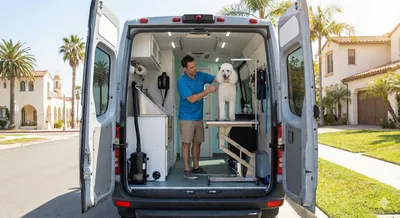
3. Mobile grooming
- Van or trailer-based grooming unit
- Travels to client locations
- Multi-jurisdiction considerations for sales tax nexus
- Wastewater disposal planning critical
Once you select a model, every subsequent step—zoning, permits, taxes, and insurance—follows from it.
Part 3: Pennsylvania Business Structure and Registration
Pennsylvania handles business registration through the Department of State.
Sole Proprietorship
A sole proprietorship requires minimal state-level filing. However:
- If you use a business name other than your legal name, you must file a Fictitious Name Registration with the Department of State
- You must register for sales tax with the Department of Revenue
- You are personally liable for all business debts and obligations
Limited Liability Company (LLC)
An LLC provides liability protection with relatively straightforward annual requirements.
Formation:
- File Certificate of Organization with the Pennsylvania Department of State
- Filing fee: $125
- Can file online through the Business One-Stop Hub
Annual Report (New as of 2025):
- Pennsylvania now requires annual reports for all LLCs
- Filing fee: $7
- Due date: September 30 of each year
- Previous decennial report requirement ($70 every 10 years) expired at end of 2024
Note: Pennsylvania’s annual reporting requirement replaced the former decennial (every 10 years) reporting system in 2025.
Corporation
Corporations file Articles of Incorporation with the Department of State.
- Filing fee: Varies by type
- Annual report: Required, $7 fee
- Subject to Pennsylvania Corporate Net Income Tax (7.99% for 2025)
Part 4: Fictitious Name Registration (DBA)
If you operate under any name other than your legal name (sole proprietors) or your exact registered entity name (LLCs/corporations), you must file a Fictitious Name Registration.
Official resource: PA Department of State - Fictitious Names
Requirements
- Filing location: Pennsylvania Department of State (not county-level like some states)
- Filing fee: $70
- Form: Registration of Fictitious Name (DSCB:54-311)
- Processing time: 7-10 business days for online filings
- Duration: Does not expire—no renewal required
- Veteran exemption: Qualified veterans and reservists file for free
Key differences from other states
Unlike California (which requires county-level DBA filing and newspaper publication), Pennsylvania handles fictitious name registration at the state level with no publication requirement. This simplifies the process significantly.
Part 5: Taxes for Pet Groomers in Pennsylvania
Pennsylvania’s tax structure includes a significant difference from states like California and Oregon: pet grooming services are subject to sales tax.
1. Sales Tax on Grooming Services — TAXABLE
This is critical: Unlike many states where services are exempt, Pennsylvania taxes pet grooming services.
Official guidance: The PA Department of Revenue confirms that grooming services are taxable.
Sales tax rates:
- Standard rate: 6% (most of Pennsylvania)
- Allegheny County: 7% (includes Pittsburgh)
- Philadelphia: 8%
What this means for groomers:
- You must collect sales tax on all grooming services
- You must obtain a Sales Tax License from the PA Department of Revenue
- You must file regular sales tax returns (monthly, quarterly, or semi-annually depending on volume)
- Retail product sales are also taxable
Exceptions:
- Veterinary services provided for health treatment are NOT taxable
- Flea/tick treatments when part of medical care are NOT taxable
- Pet boarding/sitting services are NOT taxable
To register: Apply through myPATH (Pennsylvania’s online tax system) or the Business One-Stop Hub.
2. Pennsylvania State Income Tax (Flat 3.07%)
Pennsylvania has a flat income tax rate of 3.07% on all taxable income—one of the lowest flat rates in the country.
Official resource: PA Department of Revenue - Tax Rates
Key features:
- All business income is taxed at 3.07%, regardless of amount
- No progressive brackets—same rate whether you earn $30,000 or $300,000
- Limited deductions available (HSA contributions, 529 plans, medical savings accounts)
- No standard deduction or personal exemption
For sole proprietors and pass-through entities:
- Business income passes through to your personal PA-40 tax return
- Quarterly estimated payments may be required
- Annual filing deadline: April 15
3. Local Earned Income Tax (EIT) — Critical for Pennsylvania
This is where Pennsylvania gets complex. Most municipalities levy a Local Earned Income Tax on top of state income tax.
Official resource: PA DCED - Local Income Tax Information
EIT rates:
- Most municipalities: 0.5% to 2%
- Some distressed municipalities: up to 3%
- Philadelphia: 3.75% (highest in the state, but structured differently as a wage tax)
How it works:
- Tax is based on where you live AND where you work
- You pay the higher of the two rates
- Each municipality has a PSD (Political Subdivision Code)
- Self-employed individuals file directly with their local tax collector
Example: If you live in a township with 1% EIT and operate your grooming business there, you pay 1% EIT on your net business income in addition to the 3.07% state income tax.
Finding your rate: Use the DCED EIT Rate Lookup to find your municipality’s current rate.
4. Local Services Tax (LST)
Many Pennsylvania municipalities also levy a Local Services Tax (formerly Occupational Privilege Tax).
- Maximum rate: $52 per year
- Exemptions: Some municipalities exempt those earning below a threshold
- Who pays: Anyone working in the municipality
This is a small but frequently overlooked tax.
Part 6: Philadelphia-Specific Requirements
Philadelphia has the most complex local tax structure in Pennsylvania. If you operate in Philadelphia, pay close attention.
Commercial Activity License (CAL)
Official resource: City of Philadelphia - Commercial Activity License
Requirements:
- Who needs it: Any business operating in Philadelphia
- Cost: $0 (free)
- Duration: Does not expire
- Prerequisite: Must have Philadelphia Tax ID and be current on all city taxes
To obtain:
- Register for a Philadelphia Tax Account Number
- Apply for the Commercial Activity License through Philadelphia’s Business Services
Business Income & Receipts Tax (BIRT)
Official resource: Philadelphia BIRT Information
BIRT is Philadelphia’s business tax, and it has two components:
2025 Rates:
- Net income portion: 5.71%
- Gross receipts portion: 1.410 mills (0.141%)
Important 2025 change: The $100,000 gross receipts exemption was eliminated starting tax year 2025. More small businesses are now required to file and pay BIRT.
Filing deadline: April 15 annually
Future reductions: Philadelphia is phasing down BIRT rates over the coming years, with the gross receipts portion eventually dropping to 0% by 2038.
Philadelphia Wage Tax
If you have employees in Philadelphia (or are self-employed there):
2025 Rates:
- Residents: 3.75%
- Non-residents working in Philadelphia: 3.44%
This is in addition to the state 3.07% income tax.
Net Effective Tax Rate in Philadelphia
For a self-employed groomer operating in Philadelphia, the combined tax burden is significant:
| Tax | Rate |
|---|---|
| PA State Income Tax | 3.07% |
| Philadelphia Wage Tax | 3.75% |
| Philadelphia BIRT (Net Income) | 5.71% |
| Philadelphia BIRT (Gross Receipts) | 0.141% |
| Total on Net Income | ~12.5%+ |
Philadelphia groomers face the highest tax burden in the state. Factor this into your pricing.
Part 7: Pittsburgh/Allegheny County Requirements
Pittsburgh and Allegheny County have their own considerations.
City of Pittsburgh Business License
Official resource: Pittsburgh Business Licenses
- Business licenses are issued by the Department of Permits, Licenses, and Inspections
- Licenses expire 365 days from issuance
- Late fees apply for expired licenses
Allegheny County Sales Tax
Allegheny County adds 1% to the state sales tax:
- Total sales tax rate in Allegheny County: 7%
- This applies to grooming services
Local EIT
Pittsburgh and surrounding Allegheny County municipalities have varying EIT rates. Check the DCED database for your specific municipality.
Part 8: Pennsylvania Dog Law — Does It Apply to Groomers?
Pennsylvania has a Bureau of Dog Law Enforcement under the Department of Agriculture. Understanding when it applies matters.
Kennel License Requirements
Official resource: PA Dog Laws
A kennel license is required if you:
- Keep, harbor, board, shelter, sell, give away, or transfer 26 or more dogs in a calendar year
- Operate a boarding kennel (any size)
Do Groomers Need a Kennel License?
Generally, no. Pet grooming operations where dogs are present only temporarily for grooming services (not overnight boarding) typically do not trigger kennel licensing requirements.
However:
- If you offer boarding services in addition to grooming, you need a kennel license
- If you temporarily hold 26+ dogs annually, consult with the Bureau of Dog Law Enforcement
Contact: Bureau of Dog Law Enforcement, 717-787-4833
Part 9: Zoning Requirements
Zoning approval is mandatory before opening any grooming business in Pennsylvania.
Pennsylvania’s “No-Impact Home-Based Business” Law
Pennsylvania’s Municipalities Planning Code (MPC) Section 603(l) requires all municipalities to permit no-impact home-based businesses by right in residential zones.
Definition of “no-impact”:
- Conducted as accessory use, clearly secondary to residential use
- No customer, client, or patient traffic beyond normal residential use
- No pickup, delivery, or removal functions beyond normal residential use
The problem for groomers: Most grooming operations have clients bringing pets to the location, which exceeds “no-impact” thresholds. This means:
- Home-based groomers typically cannot rely on the no-impact exemption
- You likely need a home occupation permit or variance
- Requirements vary dramatically by municipality
Storefront Zoning
Commercial spaces are generally straightforward. Verify that:
- Pet grooming is an allowed use in the zoning district
- Parking requirements can be met
- Signage is permitted
- Noise ordinances won’t create issues
Home-Based Zoning — Check Your Municipality
Official guidance: PA Business One-Stop - Local Registrations, Permits, Zoning
Each Pennsylvania municipality sets its own home occupation rules. Common restrictions include:
- Percentage of home used for business (often 25% maximum)
- Number of employees (often family members only)
- Number of clients/animals on-site at once
- Hours of operation
- Signage limitations
- Parking requirements
Action step: Contact your township or borough zoning office before starting a home-based grooming business.
Mobile Grooming Zoning
Mobile groomers face zoning issues at their home base:
- Where you park/store the vehicle matters
- Commercial vehicle storage may be prohibited in residential zones
- Your business registration address must comply with zoning
Part 10: Wastewater and Environmental Compliance
Pennsylvania regulates wastewater through the Department of Environmental Protection (DEP).
Storefront Operations
Commercial spaces typically connect to municipal sewer systems. Key considerations:
- Verify sewer connection is adequate for grooming operations
- Some municipalities may have pretreatment requirements for commercial wastewater
- Hair and chemical discharge may be regulated locally
Home-Based Operations
If your home uses a septic system:
- Commercial wastewater may exceed residential septic capacity
- Check with your municipality and DEP regional office
- You may need septic system evaluation or upgrade
If connected to municipal sewer:
- Generally fewer restrictions than septic systems
- Verify with local sewer authority
Mobile Grooming — Critical Compliance Area
Mobile groomers must:
- Capture all wastewater in holding tanks
- Dispose of wastewater properly at approved facilities
- Never discharge to storm drains, streets, or yards
Official resource: PA DEP - Wastewater Management
Illegal wastewater disposal can result in significant DEP penalties.
Part 11: Animal Welfare and Operating Standards
Pennsylvania expects groomers to follow humane handling practices, even without specific grooming regulations.
Pennsylvania Animal Cruelty Laws
The Pennsylvania Crimes Code includes animal cruelty provisions that apply to all animal businesses. Groomers must:
- Handle animals humanely
- Prevent injury through negligence
- Maintain safe, appropriate conditions
- Respond appropriately to injuries or illness
Best Practices
- Document handling procedures
- Maintain vaccination verification records
- Keep incident logs
- Establish emergency procedures
Part 12: Insurance (Not Optional in Practice)
Insurance isn’t legally mandated for most Pennsylvania groomers, but operating without it is financially reckless.
Essential Coverages
- General liability: Covers injuries to clients or property damage
- Care, custody, and control (CCC) / Animal bailee coverage: Covers injuries to pets in your care—standard homeowners policies exclude this
- Professional liability: Covers claims of negligence in grooming
- Commercial auto (mobile groomers): Covers vehicle accidents during business operations
- Property/equipment coverage: Covers grooming tools, supplies, and equipment
- Workers’ compensation: Required by Pennsylvania law if you have employees
Home-Based Groomer Warning
Homeowners insurance typically excludes business activities. If a dog is injured during grooming at your home, your homeowners policy almost certainly won’t cover it. You need separate business insurance.
Typical liability coverage: $1-2 million.
Part 13: Home-Based vs Mobile vs Storefront — Key Differences
Home-Based
Advantages:
- Lowest overhead
- No lease obligations
- Flexible schedule
Challenges:
- Most zoning-sensitive—“no-impact” exemption likely doesn’t apply
- Home occupation permit often required
- Client parking limitations
- HOA restrictions may apply
- Insurance complexity
Mobile
Advantages:
- Flexible service area
- Lower fixed costs than storefront
- No client parking issues at your location
Challenges:
- Multi-jurisdiction sales tax considerations
- Wastewater compliance critical
- Commercial vehicle insurance required
- Higher operating costs (fuel, maintenance)
- Vehicle storage zoning issues at home base
Storefront
Advantages:
- Most straightforward zoning
- Professional image
- Easier client access
- No residential neighbor conflicts
Challenges:
- Highest startup and operating costs
- Lease obligations
- Commercial space improvements may be needed
Part 14: Regional Examples
Philadelphia
Requirements typically include:
- Pennsylvania LLC or DBA registration
- Philadelphia Commercial Activity License (free)
- Philadelphia Tax Account registration
- BIRT registration and annual filing
- Zoning approval from L&I
- Sales tax license (collect 8%)
- Insurance
Total tax burden: Among the highest in Pennsylvania due to BIRT and wage tax.
Pittsburgh / Allegheny County
Requirements typically include:
- Pennsylvania LLC or DBA registration
- City of Pittsburgh business license (if in city limits)
- PA sales tax license (collect 7%)
- Local EIT registration
- Zoning verification
- Insurance
Montgomery County (Suburban Philadelphia)
Montgomery County contains over 60 municipalities, each with different requirements. Common pattern:
- Pennsylvania LLC or DBA registration
- Township or borough business license/permit (varies)
- PA sales tax license (collect 6%)
- Local EIT registration
- Home occupation permit if home-based
- Insurance
Key municipalities to check: Lower Merion, Abington, Cheltenham, Upper Dublin, Horsham
Bucks County
Similar pattern to Montgomery County—requirements vary by municipality.
Key municipalities: Bensalem, Bristol, Middletown, Newtown, Doylestown
Delaware County
Suburban Philadelphia county with municipal variation.
Key municipalities: Upper Darby, Haverford, Marple, Radnor, Springfield
Lehigh Valley (Allentown/Bethlehem/Easton)
Requirements typically include:
- Pennsylvania LLC or DBA registration
- City business license if in city limits
- PA sales tax license (collect 6%)
- Local EIT registration (rates vary)
- Zoning approval
- Insurance
Part 15: Practical Compliance Checklist
Universal (All Groomers)
- Choose business structure (sole proprietorship, LLC, corporation)
- File with PA Department of State (LLC: $125, DBA: $70)
- Obtain Federal EIN from IRS
- Register for PA sales tax license through myPATH
- Set up PA income tax withholding/estimated payments
- Register for Local Earned Income Tax with your municipality’s tax collector
- Obtain business insurance (general liability, CCC coverage)
- Set up business banking
Storefront
- Verify zoning permits commercial pet grooming
- Obtain city/township business license if required
- Confirm sewer/wastewater compliance
- Building permits if doing construction
- Fire/safety inspection if required
- Signage permit if required
Home-Based
- Confirm pet grooming allowed as home occupation in your municipality
- Obtain home occupation permit if required
- Verify septic system can handle commercial use (if applicable)
- Check HOA restrictions
- Notify insurance company; obtain business coverage
- Verify parking meets municipal requirements
Mobile
- Commercial auto insurance
- Commercial vehicle registration if required
- Wastewater holding tank and disposal plan
- Identify approved wastewater disposal locations
- Verify home base zoning allows commercial vehicle storage
- Consider multi-jurisdiction sales tax implications
Philadelphia-Specific
- Register for Philadelphia Tax Account Number
- Obtain Commercial Activity License
- Register for BIRT
- Understand wage tax obligations
- Obtain zoning approval from L&I
Part 16: Tax Summary Table
| Tax | Who Pays | Rate | When Due |
|---|---|---|---|
| PA State Income Tax | All businesses | 3.07% (flat) | April 15 (quarterly estimated if required) |
| PA Sales Tax | Groomers on services & products | 6% (most areas), 7% (Allegheny), 8% (Philadelphia) | Monthly/quarterly per volume |
| Local EIT | Most PA residents/workers | 0.5%–3.75% (varies) | Quarterly/annually |
| Local Services Tax | Workers in levying municipalities | Up to $52/year | Per pay period or annually |
| Philadelphia BIRT (Net Income) | Philadelphia businesses | 5.71% | April 15 |
| Philadelphia BIRT (Gross Receipts) | Philadelphia businesses | 0.141% | April 15 |
| Philadelphia Wage Tax | Philadelphia workers | 3.75% (residents), 3.44% (non-residents) | Per pay period |
| LLC Annual Report | All PA LLCs | $7 | September 30 |
Part 17: Common Mistakes and How to Avoid Them
Mistake 1: Not Collecting Sales Tax on Grooming Services
Unlike California, Oregon, or New York, Pennsylvania taxes grooming services. Failure to collect and remit sales tax can result in:
- Back taxes owed
- Penalties and interest
- Potential license revocation
Solution: Register for a sales tax license before your first grooming appointment.
Mistake 2: Ignoring Local Earned Income Tax
Many new business owners focus on state and federal taxes and forget EIT. This tax:
- Applies to nearly all Pennsylvania workers/business owners
- Varies by municipality
- Requires separate registration and filing
Solution: Identify your municipality’s EIT rate and tax collector immediately after starting your business.
Mistake 3: Assuming “No-Impact” Home Business Rules Apply
Pennsylvania’s no-impact home-based business law is narrower than many groomers realize. If clients come to your home:
- You likely exceed “no-impact” thresholds
- You need a home occupation permit
- You may face zoning restrictions
Solution: Contact your municipal zoning office before starting.
Mistake 4: Operating in Philadelphia Without Understanding BIRT
Philadelphia’s tax structure is complex and costly. The 2025 elimination of the $100,000 exemption means more small businesses must file.
Solution: If operating in Philadelphia, consult a tax professional familiar with city taxes.
Mistake 5: Mobile Groomers Dumping Wastewater Illegally
Pennsylvania DEP takes wastewater violations seriously.
Solution: Establish a legitimate wastewater disposal plan before starting operations.
Part 18: Resources and Contacts
State-Level
Pennsylvania Department of State
- Website: pa.gov/agencies/dos/programs/business
- Business One-Stop Hub: hub.business.pa.gov
- LLC Formation: pennsylvania-limited-liability-company
- Fictitious Names: fictitious-names
Pennsylvania Department of Revenue
- Website: pa.gov/agencies/revenue
- Tax Rates: tax-rates
- myPATH (Online Tax Filing): mypath
- Phone: 717-787-8201
Pennsylvania Department of Environmental Protection
- Website: pa.gov/agencies/dep
- Wastewater Management: wastewater-management
Bureau of Dog Law Enforcement
- Website: bureau-of-dog-law-enforcement
- PA Dog Laws: pas-dog-laws
- Phone: 717-787-4833
Local Income Tax Information
- DCED Database: dced.pa.gov/local-government/local-income-tax-information
Philadelphia
City of Philadelphia Business Services
- Website: business.phila.gov
- Commercial Activity License: get-a-commercial-activity-license
- BIRT: business-income-receipts-tax-birt
- Home-Based Business: running-a-home-based-businesses
Pittsburgh / Allegheny County
City of Pittsburgh
- Business Licenses: pittsburghpa.gov/Business-Development/Permits-Licenses-and-Inspections/Licenses/Business-Licenses
Allegheny County
- Permits and Licenses: alleghenycounty.us/Services/Permits-and-Licenses
Suburban Counties
Montgomery County
- Website: montgomerycountypa.gov
Bucks County
- Website: buckscounty.gov
Delaware County
- Website: delcopa.gov
Chester County
- Website: chesco.org
Final Reality Check
Pennsylvania makes it easy to start grooming—there’s no professional license barrier.
But Pennsylvania also creates a unique compliance burden: sales tax on grooming services combined with local Earned Income Tax that varies by municipality.
There is no groomer license—but there are:
- Sales tax collection requirements (6-8%)
- State income tax (3.07% flat)
- Local Earned Income Tax (varies, often 1-2%)
- Philadelphia BIRT (for city businesses)
- Business registration requirements
- Zoning approval requirements
- Potential municipal licensing requirements
Pennsylvania’s flat 3.07% state income tax is among the lowest in the nation, but local taxes add significant complexity. Philadelphia businesses face the highest combined burden.
If you approach setup in order—business structure —> tax registration —> zoning approval —> permits —> insurance—you avoid expensive corrections later.
Compliance protects:
- your business from penalties and closure
- your clients from liability issues
- the animals in your care
And it keeps you operating legally and sustainably.
Take the Next Step
Once you’ve navigated Pennsylvania’s licensing requirements and are ready to operate, professional grooming salon software built for independent groomers helps you manage the operational side—scheduling, client records, digital agreements, and compliance tracking—so you can focus on grooming instead of paperwork.
Start your free trial today and see how Packyard handles vaccination tracking, digital waivers, appointment management, and Square integration in one platform.
This article is informational and not legal or tax advice. Always confirm requirements with your municipality, the Pennsylvania Department of State, the Pennsylvania Department of Revenue, and qualified tax professionals before opening. Regulations, fees, and requirements change—verify current information with official sources.